 Talk AI Tools

Decktopus
The cheapest annual price in this cluster, paired with a credit rate the page states three different ways and a stated no-refund policy
Scored on the published rubric, from documentation, pricing and verified user reports.
Best for: A solo presenter who wants a deck generated from a topic and then wants coaching on delivering it, and who is willing to commit to a year up front.
Verdict
Decktopus is the cheapest annual commitment in this cluster and the only one that sells rehearsal as part of the product rather than as an afterthought.
This is a documentation review, built from the vendor's pricing page, the structured data embedded in that page and the FAQ published on it, all read on November 1, 2026. No account was opened and no first-hand claims are made below.
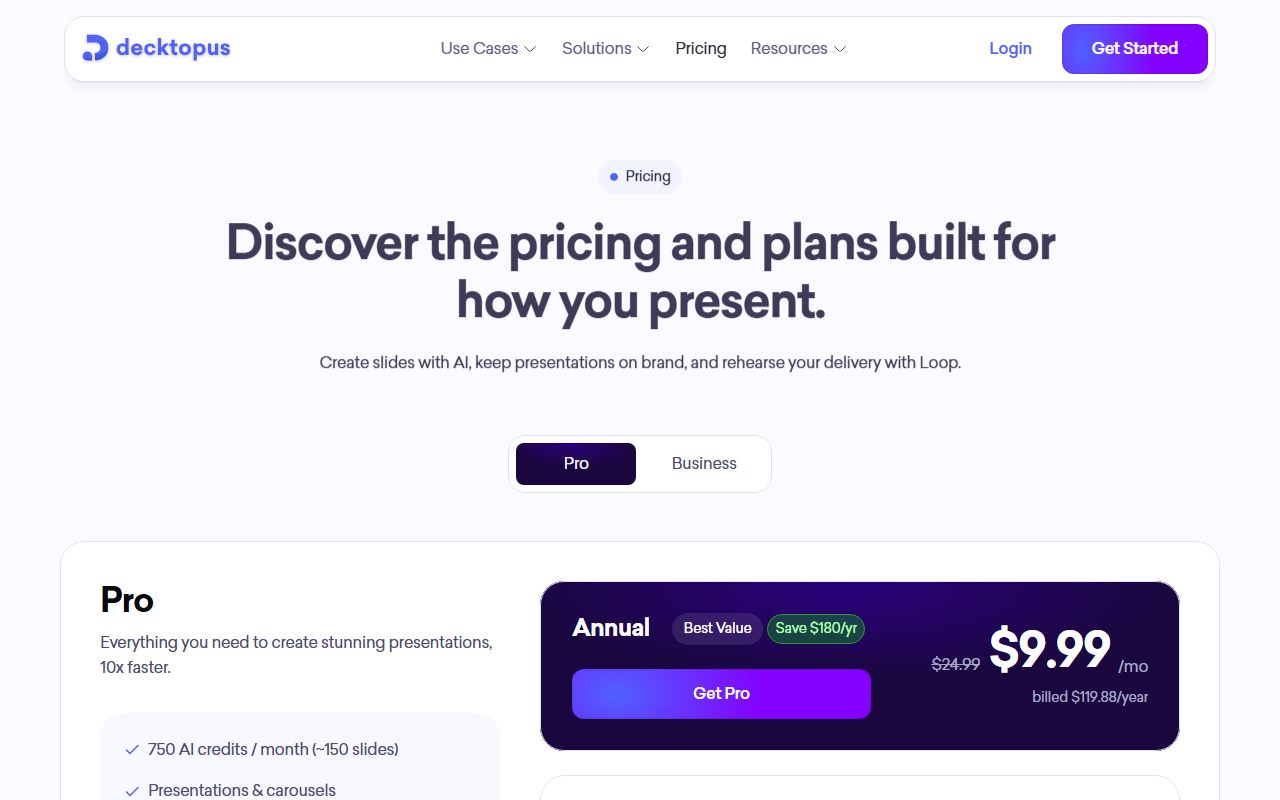
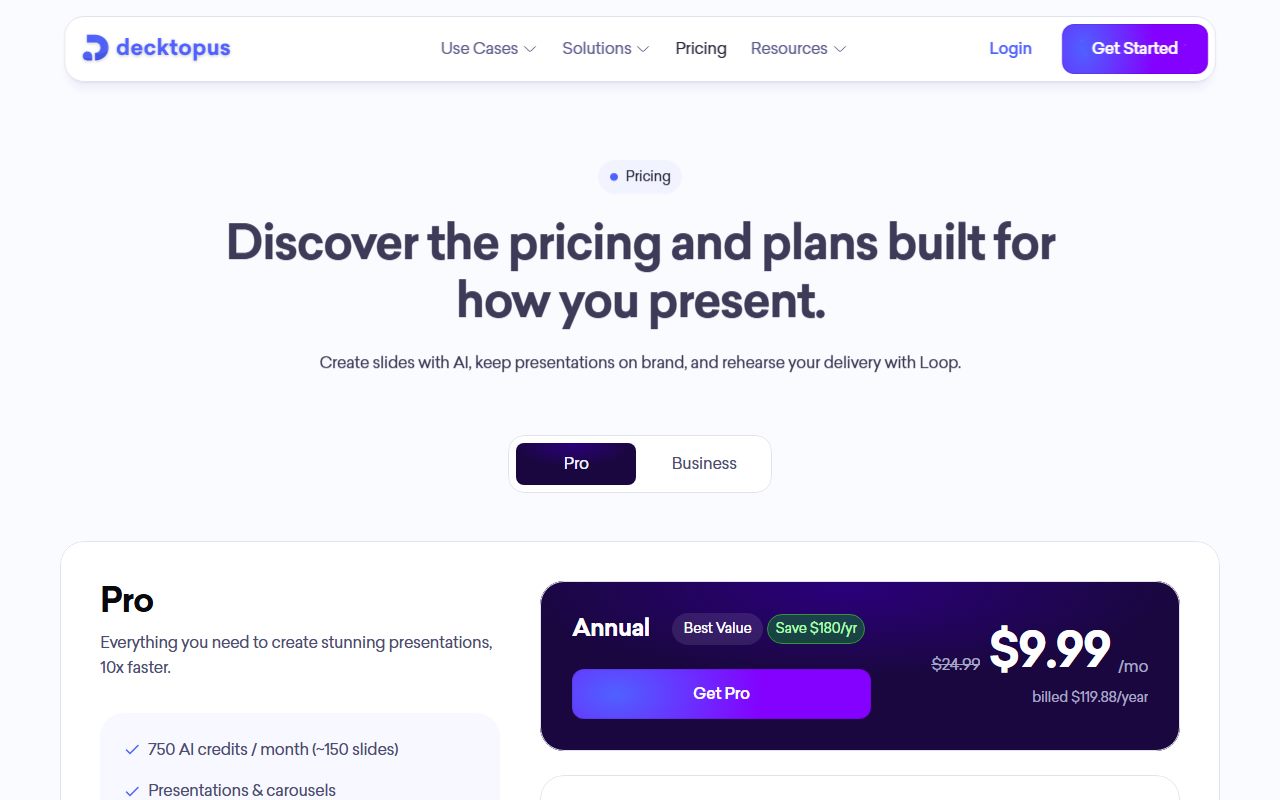
Pro is listed at $9.99 a month billed $119.88 a year. The savings badges on that page are arithmetically correct, which is worth saying out loud because many are not.
The problem is the credit rate. The Pro card says 750 credits a month is about 150 slides. The FAQ says a slide costs 5 credits and that 750 buys roughly 50 new slides. The page's own calculator says 60 slides needs about 900 credits.
Three rates, one page, one day. We print all three rather than choose.
The second problem is plainer. The FAQ states all purchases are final and non-refundable, and no free plan or free trial appears anywhere on the page.
Visit Decktopus
We have no affiliate relationship with this vendor. Link goes to the official site.
Where it is strong
- Pro billed annually is listed at $9.99 a month, invoiced as $119.88 a year, which is the lowest published annual rate in this cluster
- The savings badges check out: $24.99 across twelve months is $299.88, and the page's claimed $180 a year saving against the $119.88 annual invoice is exact
- Rehearsal is part of the product. The page describes Loop as four sequential AI agents with one persistent memory, simulating audience questions and giving feedback on pacing and clarity
- A Brand Kit is applied from a website URL rather than from a manual upload of fonts and colours, per the product description on the page
- Credit top-ups are published rather than negotiated: packages start at $4.99 for 40 credits, and the FAQ states they never expire and stack on the monthly allowance
- The FAQ states customer data is excluded from AI training by default, and that the platform runs on AWS with TLS 1.3 in transit, AES-256 at rest and MFA supported
Where it falls short
- The FAQ states all purchases are final and non-refundable, with no cooling-off window named, on a page whose cheapest option is a year paid up front
- No free plan and no free trial appear anywhere on the pricing page, so the only way in is to buy
- The credit rate is stated three ways on one page: about 150 slides for 750 credits on the plan card, roughly 50 new slides in the FAQ, and about 900 credits for 60 slides in the calculator
- The Business tier renders no price in its plan card; the figures exist only in the page's structured data, which a buyer has no reason to open
- Top-up credits are far dearer than plan credits: $4.99 for 40 credits is about nine times the per-slide rate of the annual Pro plan, by our arithmetic
- SOC 2 Type II certification is described as in progress rather than held, which matters if procurement asks for the report
At a glance
| Starting price | $9.99 a month billed $119.88 a year on Pro; $24.99 a month if billed monthly (pricing page, November 1, 2026) |
|---|---|
| Pricing note | Pro is listed at $9.99 a month billed $119.88 a year, $19.99 a month billed $59.97 every three months, or $24.99 billed monthly. The Business tier does not render a price in the plan card; the page's own structured data lists it at $19.99 a seat a month annually, $39.99 on the three-month term and $44.99 monthly (pricing page and its JSON-LD offers block, checked November 1, 2026) |
| Free plan | None listed. No free plan and no free trial appear on the pricing page read on this date |
| Business tier | $19.99 a seat a month billed annually, $39.99 on the three-month term, $44.99 monthly, read from the page's JSON-LD offers block because the card renders no price |
| Credits | 750 a month on Pro, 1,000 per seat a month on Business, Custom on Enterprise; the FAQ states a slide and an AI edit each cost 5 credits |
| Top-ups | Packages from $4.99 for 40 credits, stated never to expire and to stack on top of the monthly allowance |
| Refunds | The FAQ states all purchases are final and non-refundable; cancellation stops renewal and keeps access to the end of the period |
| Security | AWS hosting, TLS 1.3 in transit, AES-256 at rest, MFA supported, SOC 2 Type II certification stated to be in progress |
| Languages | Interface in 7 languages (English, German, Spanish, French, Portuguese, Turkish, Arabic); presentations generated in 100+ languages by prompting in that language |
| Offline use | Not supported. The FAQ states an internet connection is required to create, edit or view presentations |
| Student offer | 50 percent off all plans with the code SUPPORTEDUCATION, per the FAQ |
What Decktopus actually is
Decktopus is two products sold as one line item, and the page is clear about the split.
Studio is the generator. You enter a topic or upload a file and it produces a deck or a carousel with structure, copy and design together, rather than filling a template you chose first.
Loop is the rehearsal half. The page describes four sequential AI agents sharing one persistent memory across sessions, which simulate audience questions, listen to you practise out loud, and comment on pacing and clarity.
The page states both are included on every plan, and calls the Studio to Loop route the full workflow rather than two purchases.
Branding is automated in an unusual way. The Brand Kit is described as applied from your website URL, so the tool reads your site instead of asking for a font file.
Who Decktopus is best for
The fit is a single presenter who dreads the room more than the slides.
- A founder pitching who wants audience questions simulated before the real meeting
- A solo consultant on a tight tools budget, since $119.88 a year is the lowest annual invoice here
- A trainer or lecturer producing decks from existing documents, where a topic prompt is enough to start
- Anyone who presents from a phone, which the FAQ states is supported for creating, editing and exporting
- A multilingual team, as the FAQ states decks can be generated in over 100 languages by prompting in that language
- Someone who wants carousels as well as slides, which the plan list covers under the same credit allowance
Who should skip it
Three groups should treat the purchase as closed to them.
- Anyone who needs to evaluate first, because no free plan or trial appears on the pricing page
- Anyone who needs a refund path, since the FAQ states purchases are final
- Any team whose procurement requires a completed SOC 2 report rather than one in progress
How the pricing is structured as of November 2026
Three tiers and three billing terms, with one tier's prices missing from the visible card. All figures below come from the pricing page and the structured data inside it, read November 1, 2026.
Pro is listed three ways: $9.99 a month billed $119.88 a year, $19.99 a month billed $59.97 every three months, or $24.99 billed monthly.
Business renders no price in its card. The page's own JSON-LD offers block names $19.99 a seat a month annually, $39.99 a seat on the three-month term and $44.99 a seat monthly.
Enterprise is a demo route with Custom credits and no price. The FAQ states setup is handled by the vendor, begins with a demo environment of limited seats and credits, and takes about a week.
What separates Pro from Business is stated plainly in the FAQ: a shared workspace, Brand Kit, slide analytics, a custom domain, priority support, and 1,000 credits per seat a month instead of 750.
Students are offered 50 percent off all plans with a published code, which is more than most vendors put in writing.
The savings badges are correct, which is worth saying
We check vendor arithmetic as a matter of course, and this page passes.
The annual card carries a badge reading Save $180 a year. Monthly Pro at $24.99 across twelve months is $299.88. Subtract the $119.88 annual invoice and the saving is exactly $180.
The three-month card claims $60 a year. Four terms of $59.97 is $239.88, and $299.88 less $239.88 is exactly $60.
Both per-month figures also multiply out cleanly: $9.99 times twelve is $119.88, and $19.99 times three is $59.97.
That is four checks passed on one page. Most pricing pages we read in this category fail at least one, as the note on Grammarly's headline price set out.
The credit rate is stated three different ways
This is the finding that holds the features score down, and it is not a rounding dispute.
The Pro plan header reads 750 AI credits a month, with about 150 slides in brackets.
The FAQ on the same page states each slide costs 5 credits and each AI edit costs 5 credits. It then says the 750-credit Pro plan is enough for roughly 150 AI edits or 50 new slides.
Dividing 750 by 5 gives 150, so the figure of 50 does not follow from the vendor's own stated rate.
The built-in calculator gives a third rate. At its default position of six presentations a month, described as about 60 slides, it states you will need about 900 credits. That works out at 15 credits a slide by our arithmetic.
So one page offers 5 credits a slide, 15 credits a slide, and two different slide counts for the same allowance.
It also means the calculator's default answer is Business rather than Pro. A reader who trusts the slider is steered to the dearer tier by a figure the FAQ contradicts.
We print all three because all three were on screen on November 1, 2026. Ask support which one bills you before paying for a year.
Features: strong on rehearsal, thin on governance
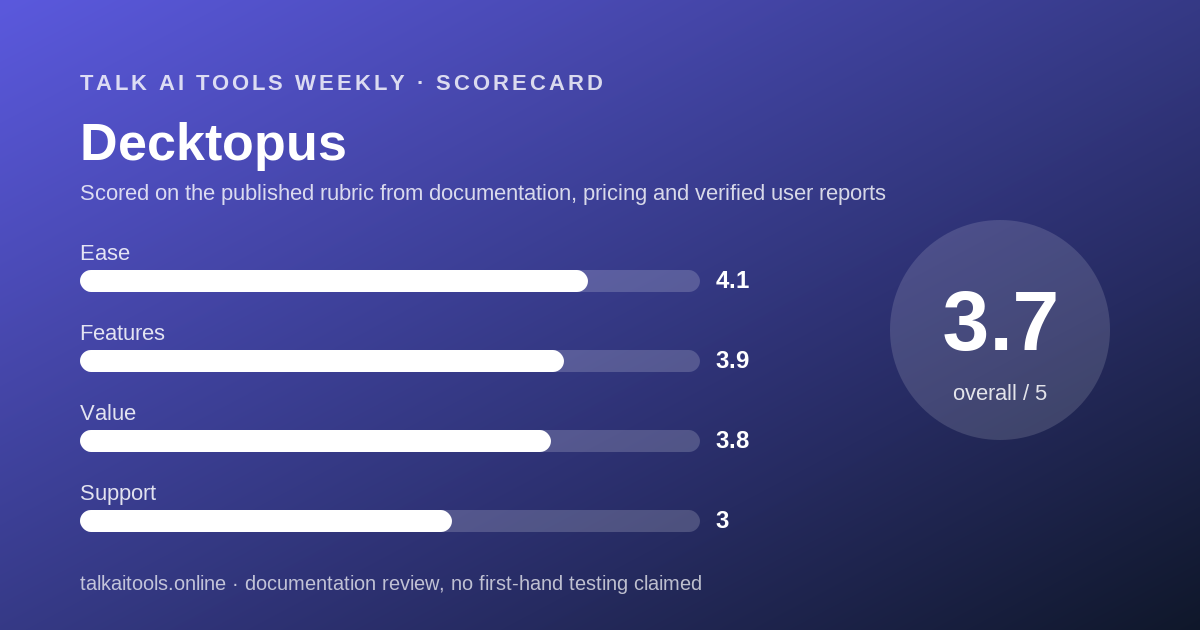
Features score 3.9 of 5. The product does an unusual job well and leaves ordinary jobs to the dearer tier.
The shared list across Pro and above covers presentations and carousels, PDF, PPT and PNG export, one-click sharing, version history and mobile access.
Loop is the differentiator and nothing else in this cluster offers it. Rehearsal with simulated questions and feedback on pacing is a different product category bolted on at no extra charge.
The governance side is where Pro empties out. Brand Kit, custom domain and the team workspace are published as Business features, and role-based access control and custom branding systems as Enterprise ones.
Storage is listed as unlimited on all three tiers, which is a real answer rather than a tiering lever.
Translation is handled by prompting rather than by a feature. The FAQ states the interface exists in seven languages while decks can be generated in over a hundred.
If the output you actually need is video rather than slides, our Descript review covers that job, and Krisp covers the call audio around it.
Ease of use: what the 4.1 is built from
Ease scores 4.1 of 5, graded on how quickly a buyer gets an answer and how clearly limits are published.
The product promise is the least work of anything here. A topic or a file in, a finished deck out, with branding pulled from a URL.
The page is also structurally helpful. Three billing terms are visible at once on the Pro tab, the comparison table is grouped into deck creation, management, branding and enterprise, and the FAQ answers refunds, security and training without being asked twice.
The deduction is the Business tab. Switching to it does not render prices into the markup, so the second tier is effectively unpriced for anyone reading the page.
The second deduction is the credit calculator, which contradicts the FAQ it sits above and points the reader at the dearer plan.
Value: cheap to start, expensive to be wrong
Value scores 3.8 of 5, graded on what the published price buys at one, three and twenty users.
At one user the annual rate is the strongest in this cluster. $119.88 a year buys 9,000 credits across the year, generation and rehearsal together.
At three users, Business at $19.99 a seat a month annually gives $59.97 a month by our arithmetic, with 3,000 credits a month pooled as 1,000 per seat.
At twenty users the same rate gives $399.80 a month, or $4,797.60 a year by our arithmetic. That undercuts both rivals in this cluster on headline seat price.
Two things pull the score back. The first is top-up pricing. A $4.99 pack of 40 credits is 8 slides at the FAQ's stated 5 credits each, about $0.62 a slide.
The annual Pro plan works out near $0.067 a slide on the card's own 150-slide figure, so top-ups cost roughly nine times as much.
The second is the refund policy. Buying a year with no refund route and no trial means the cheapest plan carries the highest risk of being money spent on the wrong tool.
Metered products that charge a premium for overflow are the pattern we described in the note on credit-metered security scanning, and the same arithmetic applies here.
Support: the weakest published commitment here
Support scores 3.0 of 5, the lowest column in this review, because the page commits to very little.
The comparison table has one support row. It reads Priority against Business and Dedicated against Enterprise. Pro carries no support label at all.
No response-time target is published for any tier, so priority and dedicated are labels rather than service levels.
The only named channel on the page is an email address for pre-purchase questions, given in the refund answer.
Given a stated no-refund policy, a buyer with a problem has no financial remedy and no published response time. That combination is what the score reflects.
We did not open a ticket and will not estimate reply times.
What the ratings on the page do and do not say
The pricing page carries several trust figures, and they do not all agree with each other.
In the visible text, read November 1, 2026, the page shows 4.8 out of 5 labelled loved by presenters, 4M+ users worldwide, a G2 High Performer badge for 2026 and Capterra 4.7 out of 5.
None of those three scores carries a review count beside it.
The structured data embedded in the same page declares something different: an aggregate rating of 4.3 with a review count of 72.
We searched the visible text of the page for both 4.3 and 72 and found neither. Google's own structured data guidance asks that a rating marked up this way be visible to readers on the page.
So we quote none of them as a user score. A 4.8 with no denominator is not a measurement, and a 4.3 from 72 that nobody can see is not a disclosure.
No G2, Capterra or Trustpilot page could be opened on the date above, so no third-party figure appears in this review. Where an aggregator could not be read, no number from it is printed.
For the same reason we do not repeat the 4M+ user figure as a fact. It is a vendor claim with no stated basis, the sort of round number we flagged across vendor pages in the week Copilot split the bill.
Alternatives worth reading before you decide
Three alternatives cover most reasons a reader would reject this tool. Figures come from each vendor's own pricing page, read November 1, 2026.
Choose Plus AI if you want the work done inside Google Slides or PowerPoint. Basic is listed at $10 a user a month billed annually, and the published credit band of 40 to 170 per task is at least a single rate.
Choose Beautiful.ai if brand enforcement is the point. Pro is listed at $14.50 a month billed annually, and a one-off month of it can be bought for $45 without an annual commitment.
Choose an inbound tool instead if the deck is not the bottleneck, in which case our Chatbase review and Buffer review cover the channels that bring people in.
Otherwise choose Decktopus if the annual price is the whole question and rehearsal is worth more to you than governance.
Bottom line
Decktopus earns 3.7 of 5 on our four-column rubric. The price is the best in this cluster and the paperwork is the worst.
It is the right pick for a solo presenter who wants a deck generated and then wants to be coached through delivering it, and who can accept a year paid up front.
It is the wrong pick for anyone who needs to evaluate first, needs a refund route, or needs to know what a month of real use will cost.
Before buying, do two things. Ask support in writing which credit rate bills you, because the page states 5 credits a slide in one place and implies 15 in another.
Then ask whether any trial exists for your region, since none appears on the page and the published refund answer is no.
Every figure above was read on the vendor's own page on November 1, 2026. For a rubric applied to a different cluster, our Surfer SEO against Frase comparison uses the same four columns.
Buy it if
- The annual price is the deciding factor, because $119.88 a year is the lowest published annual invoice in this cluster
- You are nervous about presenting, not about designing, since Loop is built around rehearsal and audience questions
- You want a deck from a topic with no template hunting, which is how the vendor describes the Studio workflow
- You present from a phone, as the FAQ states decks can be created, edited, presented and exported from mobile
Skip it if
- You need to try before paying, because there is no free plan and no trial on the page
- You need a refund route, since the FAQ states purchases are final and non-refundable
- You must forecast credits precisely, because the page states three different slide-to-credit rates
- Procurement requires a current SOC 2 report, as the certification is described as in progress
Frequently asked
Does Decktopus have a free plan?
Not on the page we read. The pricing page, checked November 1, 2026, lists Pro, Business and Enterprise with no $0 tier and no free trial. The only entry visible is a paid Pro plan on a monthly, three-month or annual term.
How much does Decktopus cost a year?
Pro is listed at $9.99 a month billed $119.88 a year. Paid monthly it is $24.99, which is $299.88 across twelve months by our arithmetic, matching the page's own claim of $180 a year saved on the annual term.
How many slides do 750 credits buy?
The page gives three answers. The Pro card says about 150 slides. The FAQ says a slide costs 5 credits and that 750 buys roughly 50 new slides. The built-in calculator says 60 slides needs about 900 credits. Ask support before relying on any of them.
What does Decktopus Business cost?
The plan card renders no price. The structured data embedded in the same page lists Business at $19.99 a seat a month billed annually, $39.99 a seat on the three-month term and $44.99 a seat billed monthly, all in US dollars, read November 1, 2026.
Can I get a refund from Decktopus?
The FAQ states all purchases are final and non-refundable, and directs pre-purchase questions to support. Cancelling stops the renewal and keeps access until the end of the current billing period, but does not return money already paid.
Does Decktopus train AI models on my decks?
The FAQ states your data is excluded from AI training by default. The same section states the platform runs on AWS with TLS 1.3 in transit and AES-256 at rest, supports multi-factor authentication, and that SOC 2 Type II certification is in progress.
What is Loop?
Loop is the rehearsal half of the product. The page describes four sequential AI agents sharing one persistent memory across sessions, which simulate audience questions, let you practise out loud and give feedback on pacing and clarity. It is listed as included on Pro and above.
Sources
- Decktopus pricing page, plan terms, comparison table and FAQ - checked November 1, 2026
- Decktopus home page, named as the application URL in the page's structured data - checked November 1, 2026
- Beautiful.ai pricing page (used in the alternatives section) - checked November 1, 2026
- Plus AI pricing page (used in the alternatives section) - checked November 1, 2026
Update history
- November 1, 2026 - First publication. The three Pro billing terms, the savings badges, the credit allowances, the comparison table and the refund, security, language and student answers read from the vendor's pricing page on this date. Business per-seat prices read from the JSON-LD offers block embedded in the same page because the plan card renders no price. The three conflicting slide-to-credit rates and the gap between the visible 4.8 rating and the 4.3 from 72 declared in structured data were both measured against the page markup on the same date. No third-party aggregator page could be opened, so no external rating is quoted.
Visit Decktopus
We have no affiliate relationship with this vendor. Link goes to the official site.