 Talk AI Tools

Buffer
A per-channel scheduler with the clearest pricing page in this cluster and a 5,000-post cap hiding inside the word unlimited
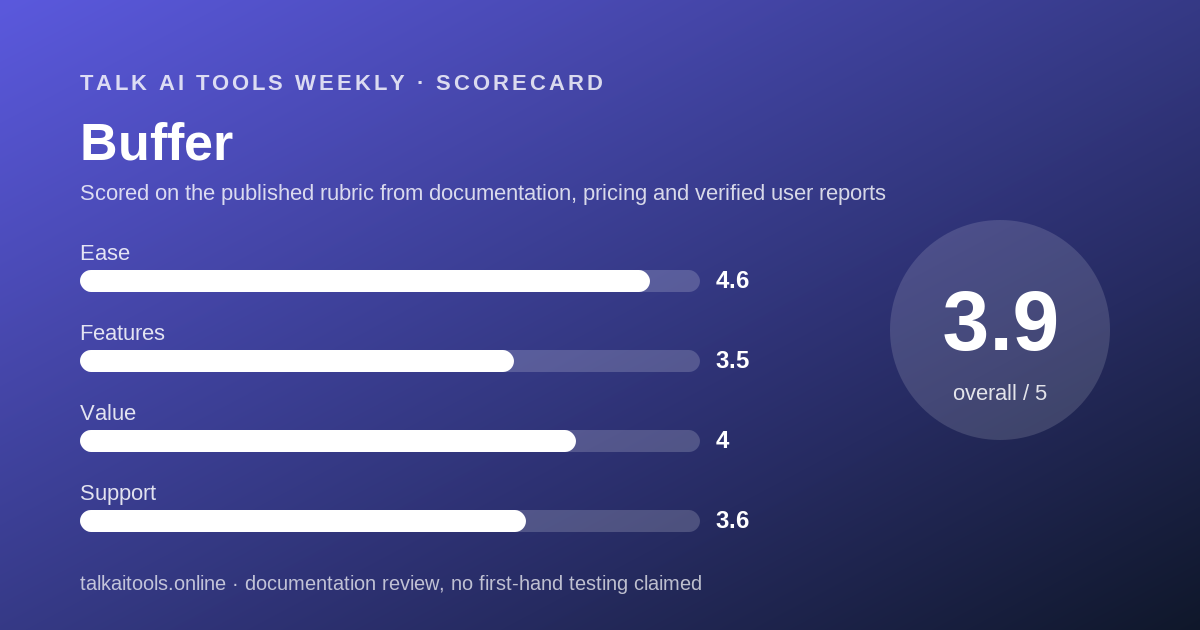
Scored on the published rubric, from documentation, pricing and verified user reports.
Best for: A small team that wants every editor inside the account without a per-seat line on the invoice, and can live with a short feature list.
Verdict
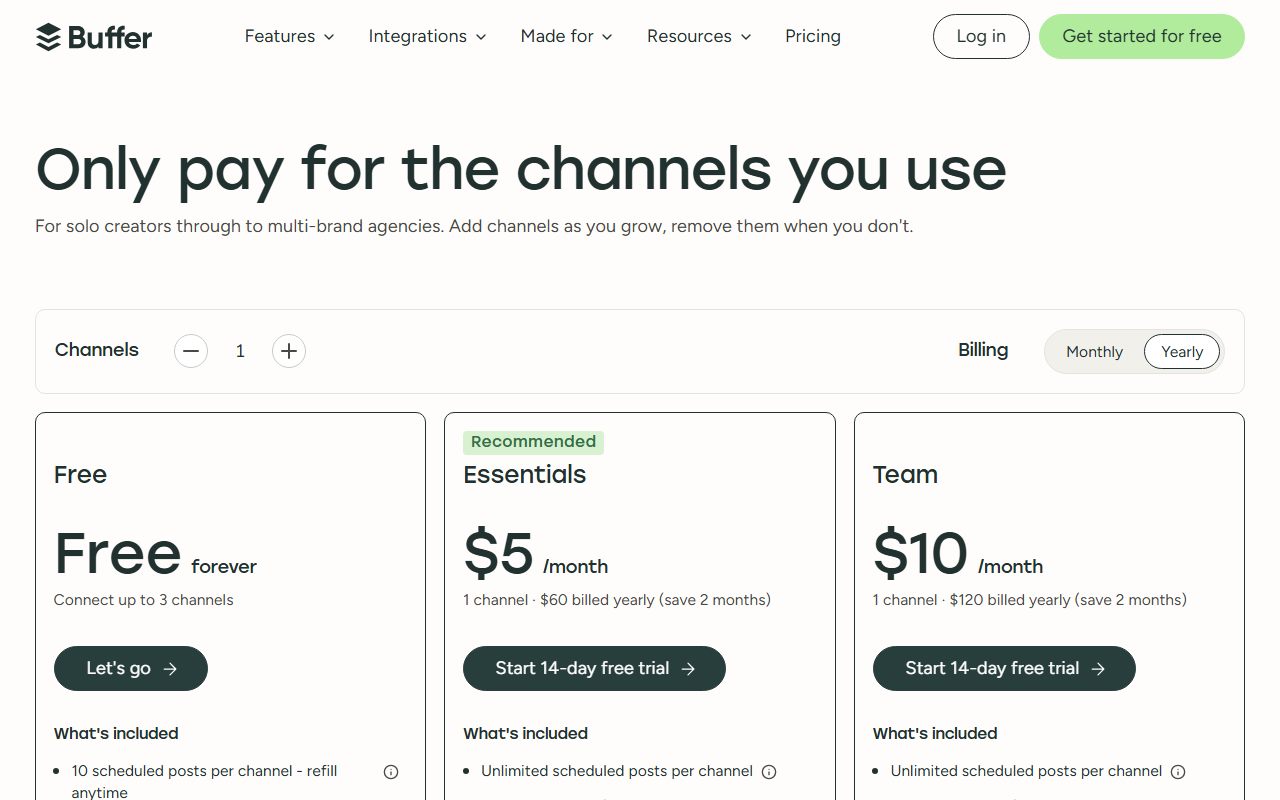
Buffer has the plainest pricing page in this cluster and the shortest feature list. This is a documentation review, built from the vendor's pricing page, the FAQ published on that same page, its sub-processor list and its privacy policy, all read on October 23, 2026; no account was opened and no first-hand claims are made anywhere below. The meter is the channel, which the vendor defines as one connected social account. Essentials is listed at $5 per channel per month and Team at $10 per channel per month, both with the Yearly toggle preselected. Team is the only plan in this cluster that publishes unlimited team members, and that is the single strongest reason a small team picks Buffer over a cheaper rival. Two things deserve a flag. The word unlimited carries a published fair-use cap of 5,000 posts per channel. And the page disagrees with itself on the annual discount: the plan card says two months free while the FAQ below it says 20 percent.
Visit Buffer
We have no affiliate relationship with this vendor. Link goes to the official site.
Where it is strong
- Team is the only plan in this cluster that publishes unlimited team members, at $10 per channel per month with annual billing (pricing page, October 23, 2026)
- The free plan connects up to 3 channels and refills its 10 scheduled posts per channel as posts publish, so it keeps working instead of expiring
- The billing unit is stated in plain words, and the vendor's own FAQ works the arithmetic: five brands with an Instagram and a Facebook page each is 10 channels
- The vendor publishes the fair-use number sitting behind the word unlimited, 5,000 posts per channel, which almost nobody in this category does
- API access appears on every tier with the key count and the monthly request ceiling printed next to each plan
- The 14-day trial on paid plans downgrades to Free rather than charging a card if no payment details are entered
Where it falls short
- The pricing page contradicts itself on annual billing: the plan card says save 2 months while the FAQ on the same page says 20 percent
- Essentials includes 1 user account, so the cheapest paid plan is a solo plan wearing a team tool's badge
- A channel volume discount above 10 channels is described but no rate is published, so a 30-channel bill cannot be worked out from the page
- Only the yearly-billed figures rendered on the page we read, so no monthly-billing rate per channel is quoted anywhere in this review
- The privacy policy was last updated September 30, 2024, and we found no plain statement on whether customer content trains the AI features
At a glance
| Starting price | $0 Free plan; $5 per channel per month on Essentials with the Yearly toggle selected (pricing page, October 23, 2026) |
|---|---|
| Pricing note | Free plan at $0 for 3 channels; Essentials listed at $5 per channel per month and Team at $10 per channel per month, both with the Yearly toggle preselected (pricing page, checked October 23, 2026) |
| Free plan | Yes - up to 3 channels, 10 scheduled posts per channel refilled as posts publish, 100 ideas, 1 user account |
| Billing unit | One channel is one connected social account; billed per channel, not per brand and not per client |
| Team seats | 1 user account on Free and Essentials; unlimited team members on Team at $10 per channel per month |
| Trial | 14 days on paid plans; the account downgrades to Free if no payment details are entered |
| Scheduling cap | Called unlimited on paid plans, with a stated fair-use cap of 5,000 posts per channel |
| API limits | 1 key and 3,000 requests a month on Free; 3 keys and 7,500 on Essentials; 5 keys and 15,000 on Team |
| Data handling | Privacy policy last updated September 30, 2024; the sub-processor table names OpenAI and Anthropic, both located in the USA |
What Buffer actually is
Buffer is a queue with a calendar on top, and the billing follows the queue rather than the person.
You connect social accounts, Buffer calls each one a channel, and you pay for channels. The vendor states this plainly: you are billed per channel, so you only pay for the accounts you actually manage.
That single decision shapes everything else. Headcount is almost free on the top plan and almost irrelevant on the bottom one. Account count is the whole invoice.
The feature set is deliberately short. Scheduling, a calendar, an ideas board, analytics, a community inbox, an AI assistant and an API. There is no competitor dashboard and no ad reporting.
If you have already read our shortlist of AI meeting note takers for small teams, the shape is familiar: a narrow tool that does one job and publishes its limits, rather than a suite that hides them.
Who Buffer is best for
The fit is a team with more people than social accounts.
- A three to six person team where everyone drafts and someone approves, because Team publishes unlimited team members
- A freelancer running a handful of client accounts who wants to add and drop channels in the same month a contract starts and ends
- A business with one brand and four or five profiles that will never need competitor benchmarking
- A developer-adjacent team that wants the publishing API included rather than sold as an enterprise add-on
- Anyone who has been burned by a vague unlimited and wants the fair-use number printed, which Buffer prints at 5,000 posts per channel
- A buyer who wants to test on three channels at $0 before any card is entered
Who should skip it
Three groups will find the feature list too short.
- Anyone who needs competitor analysis or hashtag analytics inside the subscription rather than in a second tool
- Anyone who needs a formal approval queue with roles, which the published plan list does not include at these prices
- Anyone who needs a monthly-billing quote today, because the page rendered only annual figures when we read it on October 23, 2026
What the free plan includes as of October 2026
The free tier is a working product, not a countdown. Per the pricing page read on October 23, 2026, it carries up to 3 channels, 10 scheduled posts per channel, 100 ideas and 1 user account.
The post allowance is the interesting part. The vendor states the slot becomes available again once a post publishes, up to the 10-post maximum per channel. So the limit is a queue depth, not a monthly quota.
API access survives on Free too, with 1 key and 3,000 requests a month. Very few free tiers in this category include any API at all.
One trap is published and worth reading twice. If you upgrade, the vendor states you will pay for every channel, including the ones you had while on Free. There is no grandfathered allowance.
The 14-day trial on paid plans behaves the way a trial should: no card, and the account drops back to Free rather than charging.
How the pricing is structured
There are three published tiers and one meter. All figures below are from the pricing page, checked October 23, 2026, with the Yearly toggle preselected by the vendor.
Free is $0 for up to 3 channels. Essentials is listed at $5 per channel per month, shown as $60 billed yearly for one channel. Team is listed at $10 per channel per month, shown as $120 billed yearly for one channel.
The jump from Essentials to Team buys one thing that matters: unlimited team members instead of 1 user account. The rest of the gap is API keys, 3 versus 5, and request ceilings, 7,500 versus 15,000 a month.
Above 10 channels the vendor describes a volume discount, stating channels 1 to 10 sit at the standard rate and channels above 10 cost less each. It does not publish that lower rate, so a 30-channel bill cannot be calculated from the page.
The annual discount is where the page argues with itself, and we treat that as a finding rather than a footnote. The same billing question we raised in the week Copilot split the bill applies here: read the renewal line, not the headline.
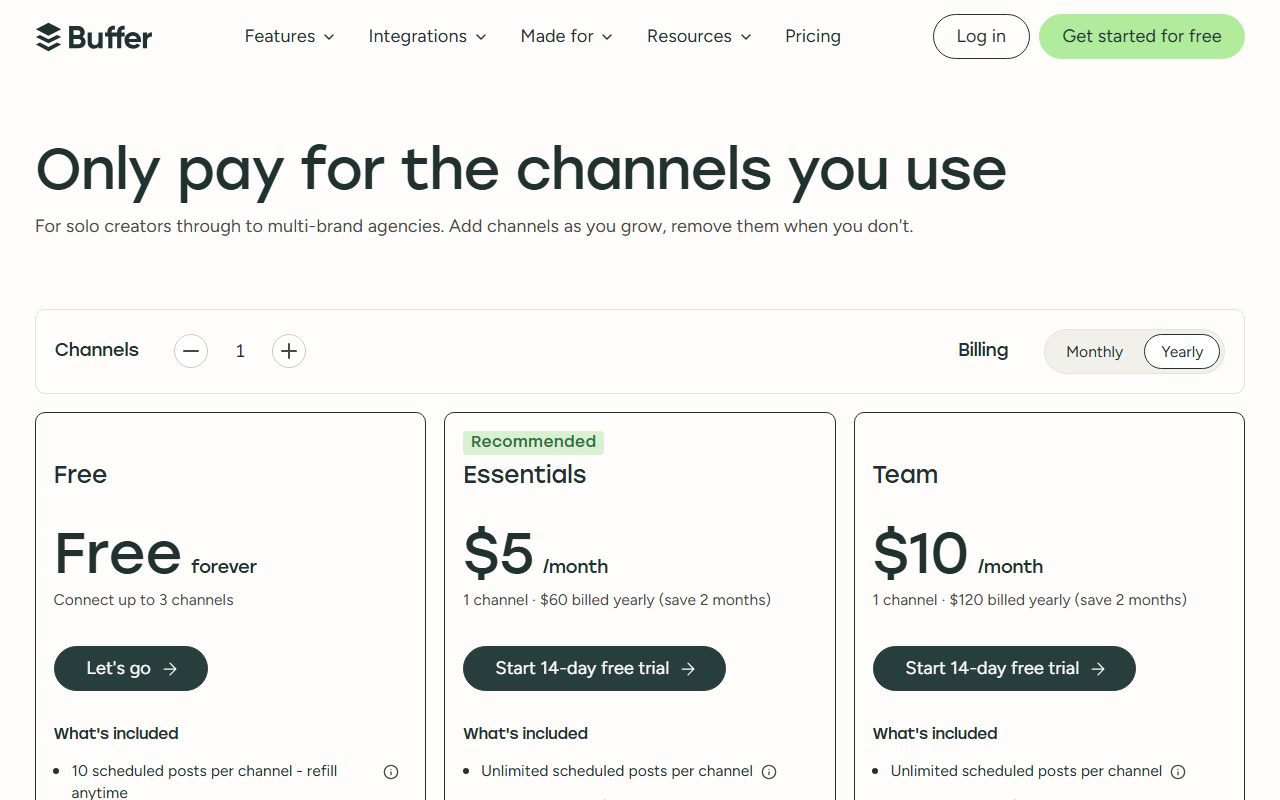
The annual discount is published twice, with two different numbers
On October 23, 2026 the pricing page carried both of these statements at once.
The plan card under Essentials read: $60 billed yearly (save 2 months). Two months off twelve is about 16.7 percent.
The billing FAQ further down the same page read: by selecting annual billing, you'll receive a 20 percent discount.
We are not going to pick one. Both figures are the vendor's, both were on screen, and they are not the same number. Confirm the discount on the checkout screen before you sign.
For the record, $5 a month across twelve months is $60, which matches the yearly figure on the card.
The monthly-billing rate per channel did not render in the page we read, so we do not print one, and we do not estimate it by dividing backwards.
Ease of use: what the 4.6 is built from
Ease scores 4.6 of 5, the highest column on this card, and it is earned on the pricing page rather than in the interface.
We grade onboarding clarity, published limits and time to a working queue. Buffer prints the channel definition, the post cap, the API ceiling and the trial behaviour without a sales call.
It also answers the question most pricing pages dodge. What happens at the end of the trial, what happens to scheduled posts, and what happens to your free channels when you upgrade are all written down.
The free plan removes the first obstacle entirely. Three channels, no card, no quote.
We deduct for one thing only: the page defaults to annual billing and does not render a monthly figure, so a buyer who wants month-to-month has to start a signup flow to learn the price.
Features: narrow on purpose, and narrow all the same
Features score 3.5 of 5, the lowest column, because the published list is short at every tier.
What is included across paid plans: unlimited scheduled posts per channel subject to the 5,000-post fair-use cap, unlimited ideas, an AI assistant, advanced analytics, a community inbox, hashtag manager and first comment scheduling.
What is not on the published list at any of the three tiers: competitor analysis, hashtag performance analytics, paid ad reporting, a role-based approval queue, or a client-facing report builder. Rivals in this cluster list several of those at $10.
The AI assistant is included everywhere, including Free, where AI replies are capped at 5 suggestions per week. On paid plans the page lists AI replies as unlimited.
If writing is the bottleneck rather than scheduling, a dedicated writing tool does more. Our Jasper review covers that case, and Surfer SEO and Frase cover the search side.
Value: the meter is the channel, not the person
Value scores 4.0 of 5, graded on what the published price buys at one, five and twenty users.
At one user with three channels, Free is genuinely enough and the score would be higher if the tier list stopped there.
At five users the model is strong. Team at $10 per channel per month publishes unlimited team members, so five people cost the same as one. On a four-channel brand that is $40 a month by our arithmetic, for the whole team.
At twenty users nothing changes, which is the point. Buffer is one of the few tools in this cluster where adding a person does not add a line to the invoice.
The weakness is the other axis. An agency with 30 client channels pays 30 times the per-channel rate, minus a volume discount the page refuses to quantify.
The AI-credit metering we tracked in the spotlight on AI credit meters at least publishes its unit price; Buffer's volume tier does not.
Support: the channels are published, the response times are not
Support scores 3.6 of 5. The plan list says world-class customer support on every tier, including Free, and that phrase is not a commitment.
We could find no response-time target for any tier on the pages we read on October 23, 2026. No first-response window, no priority queue, no named success contact.
What does exist is a useful third-party signal. Trustpilot's own transparency panel for buffer.com, read the same day, states the company replied to 88 percent of negative reviews and typically replies within 2 weeks.
Two weeks is Trustpilot's measure of public review replies, not of support tickets, and we are not going to pretend otherwise.
We did not measure response times ourselves and will not estimate them. The score reflects published channels and documentation depth, which is good, against an absent service commitment, which is not.
What verified users report
Public sentiment is positive and the sample is small enough to say so out loud.
On Trustpilot, read October 23, 2026, buffer.com carries a TrustScore of 4.1 out of 5 rated Great. The page header showed 142 reviews while the page's own structured data reported 139 on the same date, so treat the count as approximate.
Trustpilot also labels the company as one that asks customers to review, whether positive or negative. That label matters: solicited samples usually read higher than unsolicited ones, and Buffer's rivals in this cluster carry the opposite label.
At 142 reviews, one bad quarter moves the number by a tenth of a point. We report the figure and the sample size together for that reason.
We attempted no G2 figure for this review. Where a review aggregator blocked us, we say so rather than quoting a number we could not open.
Limits and data handling stated by the vendor
The documentation is thinner here than on pricing, and one date stands out.
Buffer's privacy policy carries Last updated: September 30, 2024. That is more than two years before the AI features now sold on every tier, and we could find no plain statement about whether customer content is used to train models.
The sub-processor table is more revealing. It names Amazon Web Services for hosting, Google for data storage and processing, and both OpenAI and Anthropic under the service label Artificial Intelligence. All four are listed with a USA location.
So the AI assistant routes through US providers, and the policy that governs it predates the feature. That is a fair question to put to the vendor before you paste a client's unpublished campaign into a prompt.
On transfers, the policy states personal information may move outside the EEA, the UK and Switzerland, relying on the Data Privacy Framework or approved Standard Contractual Clauses. The human-review question we raised in the spotlight on usage policy and human review is unanswered here.
Alternatives worth reading before you decide
Four alternatives cover most of the reasons a reader would reject Buffer. Figures below come from each vendor's own pricing page, read October 23, 2026.
Choose Publer if you want analytics insights, competitor analysis, best times to post and hashtag analytics inside the same $10 a month tier.
Its plans page lists Professional at $5.00 a month and Business at $10.00 a month per social account, with every tenth social account free.
Choose Metricool if data residency decides it. Its privacy policy states it carries out no international data transfers and stores all data on servers within the European Union, and its Starter plan is listed from $20 a month billed annually.
Choose SocialBee if you want unlimited AI content generation on the entry plan, listed at $29 a month billed monthly or $24.2 a month billed annually, with a 30-day money-back guarantee.
Choose Hootsuite if you are a department rather than a team. Standard is listed at $99 per user per month on annual billing for 10 social accounts, which is a different budget entirely.
Otherwise choose Buffer if headcount is your variable and channel count is stable.
Bottom line
Buffer earns 3.93 of 5 on our four-column rubric and is the clearest-priced tool in this cluster.
It is the right pick when more people than social accounts need to touch the queue, because Team publishes unlimited team members at $10 per channel per month and nothing in this category matches that.
It is the wrong pick if you expect competitor analysis, hashtag performance data or an approval queue in the same subscription. Those are not on the published list at any of the three tiers.
Before buying, do two things. Count channels rather than people, since channels are the whole invoice. Then confirm the annual discount on the checkout screen, because the page says two months free in one place and 20 percent in another.
Every figure above was read on the vendor's own pages on October 23, 2026, with the Yearly billing toggle in the state the vendor preselected. Prices in this category move; check the date before trusting the number.
For related reading, our Krisp review covers the audio side of the same workflow and Surfer SEO against Frase covers the search side.
Buy it if
- Three or more people need to be inside the account and you do not want a per-seat line on the invoice
- You count channels rather than brands, because a 30-account portfolio costs the same whether it is one client or fifteen
- You want to start at zero on three channels and add paid channels one at a time as work arrives
- You need the API, which is included on every tier with printed key counts and request ceilings
Skip it if
- You need competitor analysis, hashtag analytics or an approval workflow inside the same subscription
- You bill monthly and need the monthly rate before signing, because the page rendered only annual figures on the day we read it
- You want a support response time in writing, which no tier publishes
Frequently asked
Does Buffer have a free plan?
Yes. The pricing page, checked October 23, 2026, lists a $0 plan with up to 3 channels, 10 scheduled posts per channel, 100 ideas, 1 user account and 1 API key capped at 3,000 requests a month. The post slots refill as posts publish.
What counts as a channel on Buffer?
The vendor's FAQ defines it as one social account you connect, such as a single Instagram profile or one LinkedIn page. Billing follows that unit. Its own worked example: five brands with an Instagram and a Facebook page each is 10 channels.
How much does Buffer cost for 10 channels?
By our arithmetic on the listed rates, 10 channels is $50 a month on Essentials and $100 a month on Team with annual billing. That is our calculation, not a vendor quote. The volume discount starts above 10 channels at a rate the page does not publish.
Is Buffer's unlimited scheduling really unlimited?
No, and the vendor says so. Its FAQ states unlimited scheduling is subject to a fair use policy that caps usage at 5,000 posts per channel, adding that it uses the word unlimited because nobody has exceeded the cap.
What discount does annual billing give on Buffer?
The page gives two answers. The plan cards say save 2 months, while the billing FAQ on the same page says annual billing earns a 20 percent discount. Both were on screen on October 23, 2026. Confirm the figure at checkout before you commit.
When did Buffer last change its prices?
The pricing FAQ states pricing was last updated in November 2025. It also describes a volume discount in which channels 1 to 10 are charged at the standard rate and channels above 10 cost less each, without printing that lower rate.
Sources
- Buffer pricing page and pricing FAQ - checked October 23, 2026
- Buffer privacy policy and sub-processor table (last updated September 30, 2024) - checked October 23, 2026
- Buffer reviews on Trustpilot - checked October 23, 2026
- Publer plans page (used in the alternatives section) - checked October 23, 2026
- Metricool pricing page (used in the alternatives section) - checked October 23, 2026
- Hootsuite plans page (used in the alternatives section) - checked October 23, 2026
Update history
- October 23, 2026 - First publication. Pricing, channel definition, fair-use cap, API ceilings and trial behaviour read from the vendor's pricing page and its published FAQ on this date, with the Yearly toggle preselected; no monthly-billing rate rendered, so none is quoted. Sub-processor table and privacy policy date read the same day.
Visit Buffer
We have no affiliate relationship with this vendor. Link goes to the official site.