 Talk AI Tools
Spotlight: Claude's Usage Policy Adds a Human Reviewer Rule
This week's spotlight is a policy document, which is not a sentence that usually earns a page. It earns one because the document in question, Anthropic's 2026 Usage Policy update published October 8, 2026 and effective November 12, is the first time a major model vendor has written down, in a place a small business can read, who must be in the room when the model decides something about a person. Then five short notes, each linked to its source. Everything below was read from the vendors' own pages on October 10, 2026.
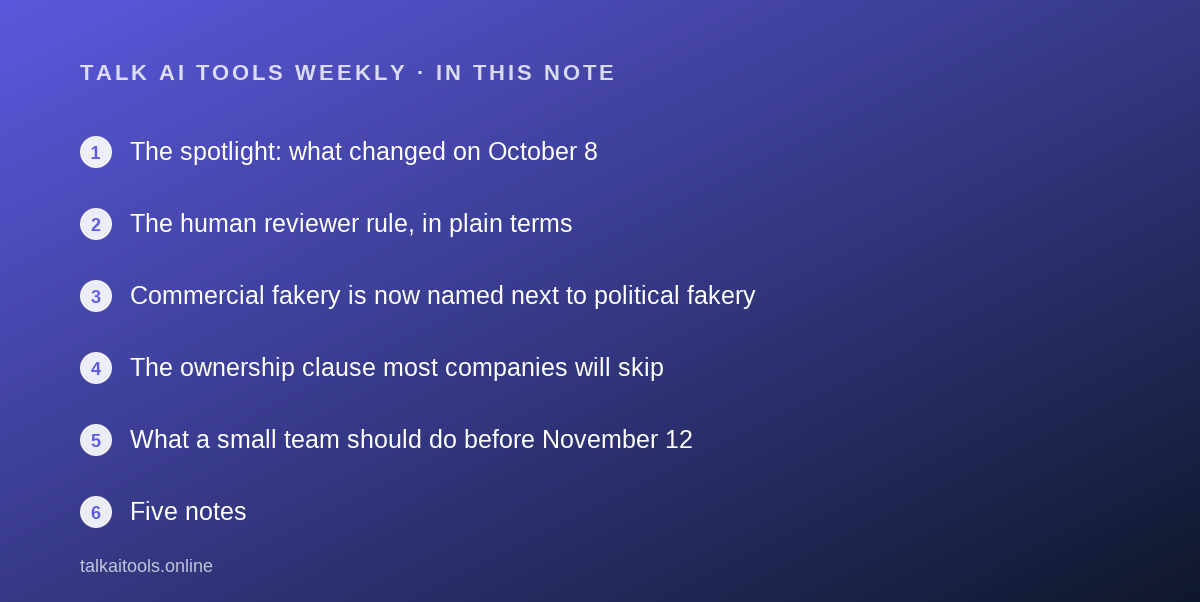
The spotlight: what changed on October 8
com/news/2026-usage-policy-update) walks through the sections. Most of them concern weapons, surveillance, and elections, and the headlines elsewhere will be about those. The weapons ban now explicitly covers guidance and control software and the act of arming drones or vehicles.
The surveillance section bars tracking people without consent, whether live or by analysing old data, and bars using Claude to decide whom to investigate, arrest or charge.
One rule was relaxed: the blanket ban on personalised voter and campaign targeting is gone, replaced by narrower rules against deceiving voters, so that a nonprofit producing multilingual voting information is no longer caught. The section on elections has been renamed around undermining democratic processes rather than around political content as such.
Two sections reach an ordinary small company directly. One is the new consolidated rule against deceptive campaigns and artificial activity. The other is the revised rule on high-risk uses. The rest of this spotlight is about those two.
The human reviewer rule, in plain terms
Per the post, when Claude is used in a way that affects a person's health, legal rights, finances, livelihood or access to essential services, three things are required. A qualified human must be able to review the model's recommendation. That human must have the authority to change it. And the affected individual must be told that AI was involved.
The post says the revised section now lists which kinds of recommendation are covered, and it adds a new clause for Claude connected to hardware that acts in the physical world: a qualified operator must be able to watch it and stop it, and the equipment must fall to a safe state if the model is disconnected.
What this means for a small business is less abstract than it sounds.
A letting agent that runs applications through a Claude-based screening tool, a clinic that triages patient messages with it, a lender scoring applicants, a recruiter shortlisting candidates: each now needs a named person who can overrule the output and a line of disclosure to the applicant.
The post does not say how the rule applies to any specific setup, and it points to the full policy for that.
Commercial fakery is now named next to political fakery
The new section on deceptive campaigns consolidates earlier rules against fake account networks, fabricated news sites and influence operations, and the post states that it applies to commercial activity as well as political activity. That sentence is the one a marketing team should read.
Generating a batch of customer reviews, a set of forum accounts that recommend your product, or a news-looking site that exists to funnel traffic: these were already a regulatory problem under consumer-protection law in most markets. From November 12 they are also a usage-policy problem, which means the vendor can act on them without waiting for a regulator.
The ownership clause most companies will skip
The post restates the Supported Regions rule and widens it: use is barred not only for people physically in an unsupported region but for entities incorporated or headquartered there, and for entities majority-owned or controlled by persons or entities from there.
A small company with a majority investor from an unsupported region is covered even if every employee sits somewhere supported. The Supported Regions page is where to check, and the post does not elaborate further.
What a small team should do before November 12
- List every place Claude, directly or inside another product, produces a recommendation about a person's money, health, housing, employment or benefits. If the list is empty, you are done.
- For each item on the list, name the human who reviews and can overrule the output, and write the name down with the date.
- Add a disclosure sentence to the relevant form, letter or email template telling the person that AI was used.
- Ask your marketing agency, in writing, whether any content they produce for you is synthetic reviews or synthetic accounts; the answer should be no, and now you have it on file.
- If you have a majority investor, check their jurisdiction against the Supported Regions page.
Five notes
- GitHub added, on October 8, 2026, an organisation setting that bills Copilot code review to the organisation instead of each member's own quota, with an optional budget, plus a control that restricts review requests to authorised users; it requires AI Credits paid usage and the per-review price is not printed on the changelog. [Source](https://github.blog/changelog/2026-10-08-copilot-code-review-new-organization-billing-options-and-controls).
- Also on October 8, GitHub let repository maintainers count draft pull requests toward pull-request limits, closing a gap that allowed unlimited drafts and, per the page, cutting clutter, notifications and CI runs; no numeric caps are stated. [Source](https://github.blog/changelog/2026-10-08-draft-pull-requests-count-toward-pull-request-limits).
- Microsoft's October 8, 2026 post put a Sales Development Agent into public preview, researching prospects and sending outreach from its own Exchange account, and set November 16, 2026 as the date it begins consuming Copilot credits; no rate is given. [Source](https://www.microsoft.com/en-us/copilot/blog/2026/10/08/bringing-crm-into-the-flow-of-work-and-agents-into-business-process-for-sales-and-service-teams/).
- Anthropic's Cyber Mission, announced October 8, 2026, includes a free opt-in OSS Scanner that periodically checks critical open-source projects with its most capable models and sends unreviewed reports with a suggested fix, plus free Claude Max subscriptions for approved maintainers. [Source](https://www.anthropic.com/news/anthropic-cyber-mission).
- Slack's October 2026 changelog adds the ability for a workflow to start a conversation with Slackbot or an agent automatically, using information collected earlier in the workflow; the entry does not state plan availability. [Source](https://slack.com/changelog).
A pattern across the five: four of them are about control, who may trigger a review, whether drafts count, when an agent starts costing credits, what a workflow may hand to an agent.
Only the OSS Scanner is a straightforward gift, and it is a gift to maintainers rather than to companies. The week's quiet theme is that the interesting settings are now in the administrator's panel, not in the model picker.
Bottom line
Anthropic's policy update is not a reason to stop using Claude for anything a small business was sensibly using it for.
It is a reason to write three things down before November 12: where the model touches a decision about a person, who can overrule it, and how the person is told. Most ten-person companies will find the list is short or empty.
The ones that find it is not should be glad to have found out from a policy page rather than from a complaint.
Last week's spotlight was about the price of small models falling by ninety percent; the week before that, Microsoft's two-part Copilot bill. Next week GitHub puts secret scanning on an AI Credit meter. One spotlight, five notes, every source linked.
Sources
- Anthropic: 2026 Usage Policy update - checked October 10, 2026
- GitHub changelog: Copilot code review, new organization billing options and controls - checked October 10, 2026
- GitHub changelog: Draft pull requests count toward pull request limits - checked October 10, 2026
- Microsoft: Bringing CRM into the flow of work and agents into business process - checked October 10, 2026
- Anthropic: Introducing the Anthropic Cyber Mission - checked October 10, 2026
- Slack changelog, October 2026 - checked October 10, 2026