 Talk AI Tools

Chatbase
An AI agent builder for your website, metered in message credits that cost more on bigger models
Scored on the published rubric, from documentation, pricing and verified user reports.
Best for: A site that needs the bot to do something, not just answer: collect a lead, book a call, check an order, hand off to a human.
Verdict
Chatbase is the most capable AI agent in this cluster and the most expensive place to start. This is a documentation review, built from the vendor's pricing page, its public documentation and its privacy policy, all read on October 11, 2026; no account was opened and no first-hand claims are made. There is no permanently free plan. The entry point is Hobby at $40 a month, or $34 a month billed annually, for 700 message credits, one AI agent and two team seats. What that money buys is unusually well documented: six training source types, a published list of models with the credit cost of each, pre-built actions for Slack, Stripe, Calendly, lead collection and web search, and custom actions against any API. The credit meter is the thing to understand before you buy, because a single answer can cost one credit or six depending on the model you select.
Visit Chatbase
We have no affiliate relationship with this vendor. Link goes to the official site.
Where it is strong
- Six documented training source types, including website crawl, Notion pages and Salesforce or Zendesk tickets
- The documentation publishes the message-credit cost of every model, so the meter is inspectable before you commit
- Pre-built actions for human escalation, Slack, Stripe, Calendly, lead collection and web search, plus custom actions against any API
- Annual billing is a flat 20 percent off, taking Hobby to $34 a month, stated plainly on the pricing page
- The privacy policy states customer data is not used to train AI models and that retrieval-augmented generation is used instead
Where it falls short
- No permanently free plan; the pricing page offers only a 7-day trial
- Every published plan includes exactly one AI agent, with extras at $25 per agent a month
- Removing Chatbase branding costs $99 a month, which is more than twice the Hobby plan it sits on
- Team seats are tight: two on Hobby, three on Standard, five on Pro
- A homepage figure of 4.8 appears without a stated source, and data is processed in AWS us-east-1 with no EU region documented
At a glance
| Starting price | $40/mo Hobby, or $34/mo billed annually (pricing page, October 11, 2026) |
|---|---|
| Pricing note | From $40/mo, or $34/mo billed annually, for 700 message credits and one agent (pricing page, checked October 11, 2026) |
| Free plan | No - a 7-day trial only |
| Seat minimum | Not a seat model; seats are capped at 2 on Hobby, 3 on Standard, 5 on Pro |
| Trial | 7 days |
| AI pricing | 700 credits/mo on Hobby, 4,000 on Standard, 15,000 on Pro; auto-recharge at $40 per 1,000 credits |
| Support channels | Not published per plan; public documentation is detailed and structured |
| Data residency | AWS us-east-1 in the United States, per the privacy policy; no EU region documented |
What Chatbase actually is
Chatbase is an agent builder, not a chat inbox. The difference changes who should buy it.
You point it at your content, pick a model, write instructions, attach actions and drop the agent on a site. There is no shared human inbox at the centre of the product the way there is in Tidio or Crisp.
That focus shows in the deployment list. The documentation names Website, Email, Meta Apps, Shopify, Phone, Slack and Zendesk as places an agent can live. Zendesk appears as a destination, not a competitor.
It also shows in the seat counts. Hobby allows two team members, Standard three, Pro five. Those are builder seats, not agent seats, and they are a clear signal that nobody expects a support team to live here.
Our shortlist of AI chatbots for a small business site ranks Chatbase first on the rubric and explains why the price still makes it the wrong first purchase for many readers.
Who Chatbase is best for
The fit is narrower than the marketing suggests, and the narrowness is a strength.
- A site where the useful answer requires a lookup or a booking, not a paragraph from a help article
- A solo founder or two-person team happy to build and maintain one agent carefully
- A business whose knowledge is scattered across a website, a Notion workspace and a pile of PDFs
- A buyer who wants to audit the cost per answer before launch rather than discover it on an invoice
- A team that already runs Zendesk or Salesforce and wants an AI layer trained on existing tickets
- Anyone who needs the agent to hand off to a human in Slack rather than hold the conversation alone
Who should skip it
Three reasons to walk away, all of them printed on the vendor's own pages.
- You need a free starting point, because there is none - Tidio and Crisp both have a $0 plan
- You need more than five people inside the tool, which no published plan allows
- You need more than one agent without paying $25 a month for each additional one
What you get for $40 a month as of October 2026
There is no free tier to analyse, so the entry plan is the thing to read carefully. Figures below come from the pricing page, checked October 11, 2026.
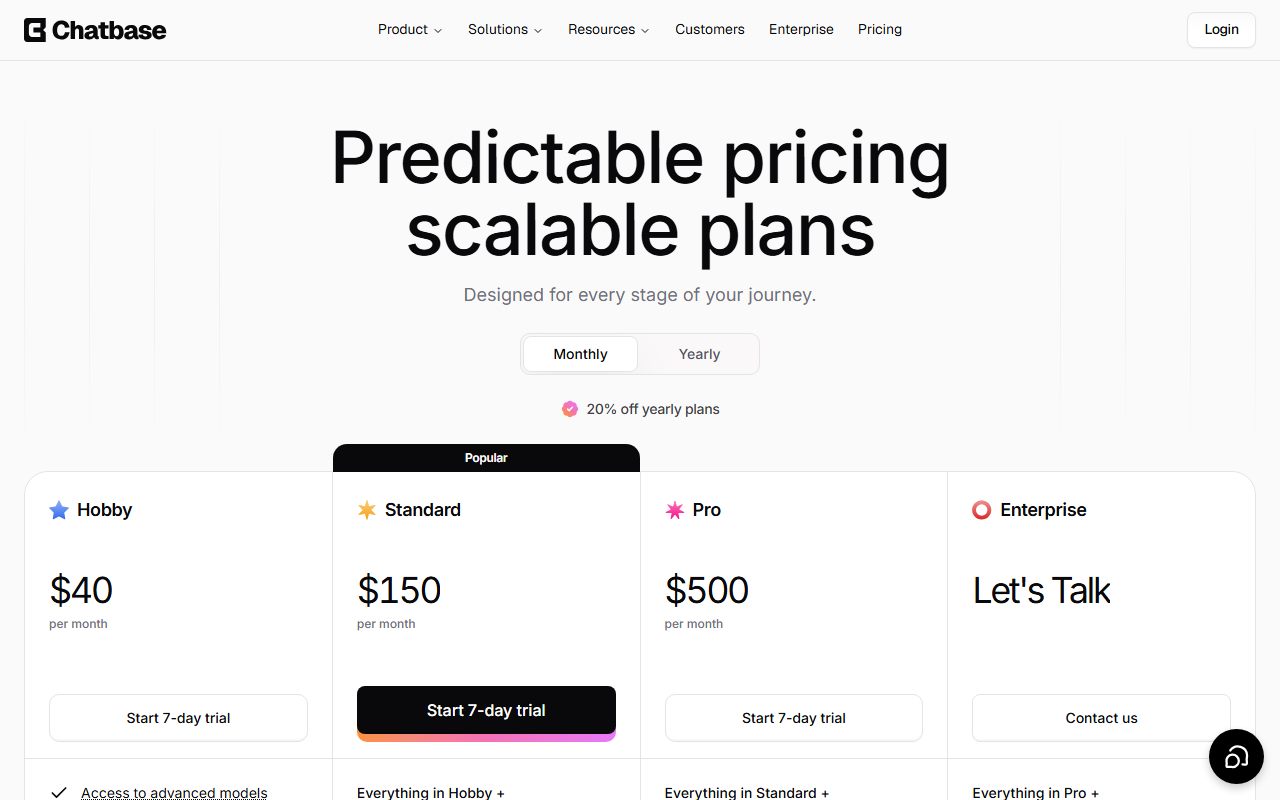
Hobby is $40 a month, or $34 a month billed annually, and includes 700 message credits a month, 200 test credits a month, one AI agent and two team seats.
Test credits are a quiet but good idea: they let you exercise the agent in the builder without burning the allowance your visitors need.
By our arithmetic, Hobby billed annually is $408 a year. That is the real number to compare against the free plans elsewhere in this cluster.
What is not included at any published tier is a second agent. Extra agents are $25 a month each. A business with a support bot and a separate sales bot is therefore paying $65 a month at the Hobby level before any credit overage.
How the pricing is structured
Three published tiers, one meter, three add-ons. The meter is the part that decides your bill.
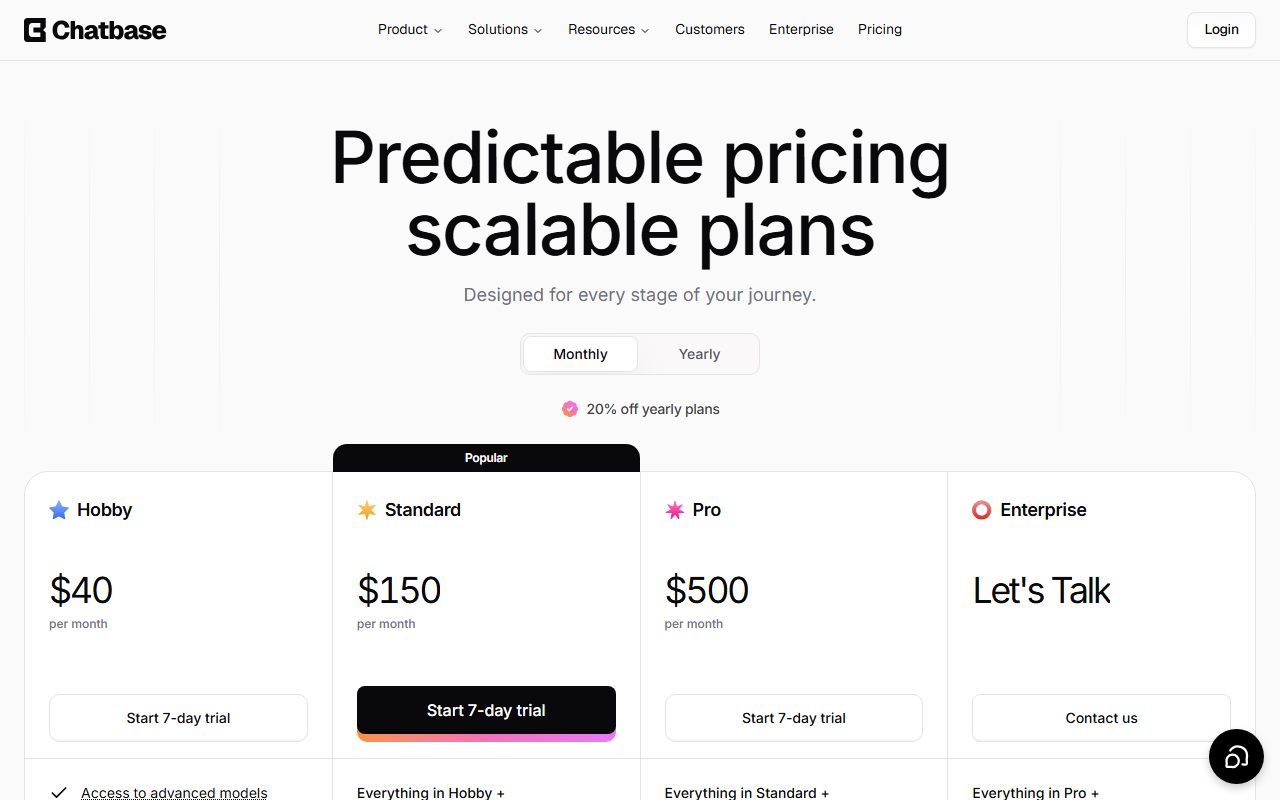
Standard is $150 a month, or $127.50 annually, with 4,000 message credits, 500 test credits, one agent and three seats. Pro is $500 a month, or $425 annually, with 15,000 message credits, 1,000 test credits, one agent and five seats. Enterprise is quoted on request.
The annual discount is a flat 20 percent across the board, which the pricing page states directly.
Credit economics improve as you climb. Our arithmetic from the published figures: Hobby is about $0.057 a credit, Standard about $0.0375, Pro about $0.033. Auto-recharge sits at $40 per 1,000 credits, or $0.04 a credit, so topping up a Hobby plan is cheaper per credit than the plan itself.
Two add-ons can dominate a small bill. Extra agents are $25 a month. Removing Chatbase branding is $99 a month, which is more than twice the Hobby plan. For a brand-sensitive storefront, the real floor is $139 a month, not $40.
Ease of use: what the score is built from
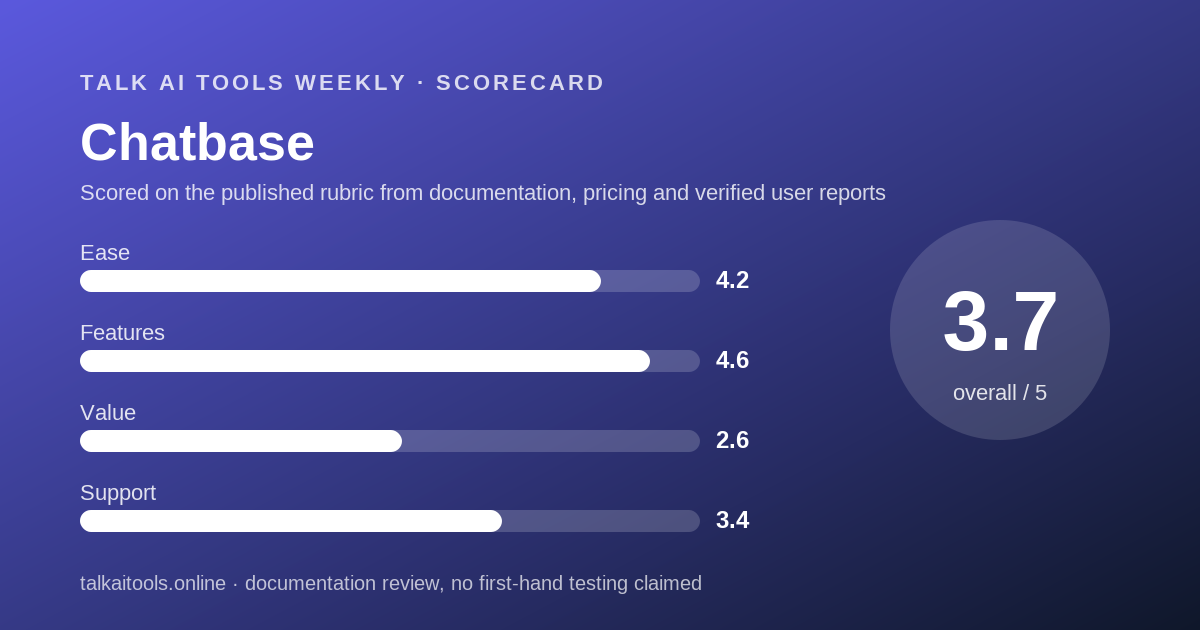
Ease scores 4.2 of 5. The points come from documentation quality and from how few decisions stand between you and a working agent.
The build flow is linear: add sources, choose a model, set instructions, attach actions, publish. Nothing in the published documentation suggests a configuration maze.
Source handling is specific rather than magical. The documentation lists files, text snippets, website content by crawl or sitemap or individual link, Q and A pairs, Notion pages and support tickets from Salesforce or Zendesk.
It also prints the awkward limits, which is what honest documentation looks like: files up to 20 MB each, text must be selectable, and scanned PDFs with no text layer cannot be trained on.
We deduct for the absence of a free plan. A 7-day trial is enough to see the interface and not enough to see a month of real traffic, so the first real decision is made with less evidence than a free tier would give you.
Features: the strongest column on the card
Features score 4.6 of 5, the highest score in this cluster, and it is earned on actions and model choice rather than channel count.
Actions are the differentiator. The documentation lists pre-built actions for human escalation, Slack, Stripe, Calendly, lead collection and web search, plus custom actions to integrate with any API. Neither Tidio nor Crisp documents an equivalent set.
Model choice is broad and, more importantly, priced in the open. The documentation lists models from several providers with the credit cost of each: Chatbase Auto at one credit, GPT models from one to four, Claude models from one to six, Gemini models at one or two, with Llama, DeepSeek, Grok, Mistral, Kimi and GLM models in the one to four range.
Voice is documented with its own rate: 6 message credits a minute of conversation, on top of the model credits each response consumes.
The documentation is also explicit that one customer message can trigger two or more model requests when an action fires. That single sentence is the most useful thing on the whole pricing question, and it is in the docs rather than on the pricing page.
Value: the weakest column, and not a close call
Value scores 2.6 of 5, graded on what the published price buys at one, five and twenty users.
At one user, $40 a month buys 700 credits and one agent. On a six-credit model that is roughly 116 answers a month by our arithmetic, which a modest storefront can exhaust in a week.
At five users you are on Pro at $500 a month, because Hobby caps at two seats and Standard at three. Five people is the first point where the price is set by seat limits rather than by usage.
At twenty users there is no published answer. The plans stop at five seats and the next step is an Enterprise quote, so we do not estimate.
The branding add-on makes this worse for the exact buyer the entry plan is aimed at. A small business that does not want a vendor badge on its website chat is quoted $99 a month for its removal, on top of a $40 plan.
For straight price per seat at a small team, Crisp is several times cheaper, and our Tidio against Crisp comparison covers that end of the market.
Support: excellent documents, undocumented channels
Support scores 3.4 of 5. The documentation carries the score; the channel list drags it down.
The public documentation is the best of the three tools here. It is structured by task, it names limits in numbers, and it publishes the credit cost table that determines your bill. Most vendors keep that behind a login.
What we could not find on October 11, 2026 is a published statement of which support channels each plan receives, or any response-time commitment. The pricing page does not print one.
So the grade reflects help-centre quality plus the absence of published channels and response times. We did not measure response times ourselves and will not estimate them.
One more gap worth naming: the homepage shows a figure of 4.8 beside the claim of being the leading AI agent for customer experience, with no source stated for where that rating comes from. An unsourced number on a vendor homepage is not evidence, and we do not repeat it as one.
What verified users report
Public sentiment is the best in this cluster, on a sample too small to lean on hard.
On Trustpilot, read October 11, 2026, Chatbase holds a TrustScore of 4.0 out of 5 across 68 reviews, with 56 percent five-star and 28 percent one-star.
Sixty-eight reviews is a small base. A score built on that many entries can move half a point in a month, so treat it as a weak signal rather than a verdict.
The homepage states the product is trusted by over 10,000 brands. We report that as a vendor claim because we have no way to verify a customer count from outside.
For context, Tidio sits at 3.6 out of 5 from 226 reviews and Crisp at 2.0 out of 5 from 55 reviews on the same date.
We attempted to read G2 for this cluster on October 11, 2026 and received HTTP 403, so no G2 rating appears in any article here. Trustpilot is the only public review source we could actually read, and that limitation is part of our method rather than a footnote to it.
Limits and data handling stated by the vendor
Chatbase makes the clearest AI-training promise in this cluster and offers the least choice about geography.
The privacy policy states the company does not use your data to train AI models, and that it uses retrieval-augmented generation to generate responses without compromising your data. That is the unambiguous sentence buyers should look for.
It also states the company is GDPR and SOC 2 compliant, and that it enters into binding standard data protection clauses under GDPR Article 46.
Location is the trade-off. The policy states the database and application run on AWS infrastructure in us-east-1, managed through providers including Supabase and Vercel. No EU or UK region is documented, which matters for a reader with European customers.
Deletion is bounded and stated: conversation content, attachments and contact information are deleted within thirty days of a written deletion request or termination of the agreement. Sub-processors are published at the company's trust centre.
No last-updated date was visible on the privacy page when we read it on October 11, 2026, which is a small but real gap for a document you are meant to rely on.
Alternatives worth reading before you decide
Most readers who reject Chatbase do so on price, and there are two straightforward exits.
Choose Tidio if you want to begin at $0 and your bot's job is to answer questions rather than take actions. Its free plan carries 50 billable conversations a month and up to 10 seats, with the Lyro AI add-on from $32.50 a month. Detail is in our Tidio review.
Choose Crisp if you need several people in a shared inbox at a flat monthly figure. Mini is $45 a month per workspace with four seats included and extra seats at $10 a month, though the AI chatbot does not appear until the $95 Essentials plan. Detail is in our Crisp review.
Choose Intercom if you are a support organisation rather than a small site. Its pricing page, checked October 11, 2026, lists Essential at $29 a seat a month, Advanced at $85 and Expert at $132, with the Fin AI agent from $0.99 per outcome.
Otherwise choose Chatbase if the agent has to do something measurable, you can live with one agent and two seats, and $40 a month is an acceptable floor.
Bottom line
Chatbase earns 3.7 of 5 on our four-column rubric and takes the top spot in this cluster on capability, not on price.
Buy it when the answer your visitors need requires a lookup, a booking or a handoff, and when you are willing to read a credit table before you launch.
Do not buy it as a cheap chat widget. With no free plan, two seats on the entry tier and $99 a month to remove the vendor badge, it is the most expensive starting line here by a wide margin.
The single most useful preparation is arithmetic: estimate your monthly conversations, multiply by the credit cost of the model you intend to use, remember that an action can trigger a second request, and compare the total with the metered approach in our Tidio review and the bundled approach in our Crisp review. The head-to-head between those two sits in Tidio against Crisp.
Credit meters are spreading across small-team software this year, a pattern we traced in the spotlight on AI credit meters and in the week Copilot split the bill. Every figure above was read on the vendor's own pages on October 11, 2026.
Buy it if
- You need the bot to take an action, not only answer, because actions are documented and pre-built
- Your knowledge lives in several places, since files, website, Q and A pairs, Notion and support tickets are all supported sources
- You want to audit the meter, because the model credit table is published rather than hidden
- One agent is enough, since every published plan includes exactly one
Skip it if
- You need to start at zero, because there is no free plan
- You need more than five people in the tool, which the published plans do not allow
- You need EU or UK data residency, which the privacy policy does not document
Frequently asked
Does Chatbase have a free plan?
No. The pricing page, checked October 11, 2026, lists a 7-day trial and the homepage button reads start free trial. The cheapest published paid plan is Hobby at $40 a month, or $34 a month billed annually.
What is a message credit on Chatbase?
One request to the AI model, priced by model. The documentation lists Chatbase Auto and several small models at one credit per request, mid-tier models at two to four, and the largest Claude models at five or six.
How many answers does the Hobby plan actually buy?
It depends entirely on the model. Hobby includes 700 message credits a month. On a one-credit model that is 700 requests; on a six-credit model it is about 116 by our arithmetic, before any action triggers a second request.
What happens when credits run out?
The pricing page lists auto-recharge at $40 per 1,000 message credits. By our arithmetic that is $0.04 a credit, slightly cheaper than the $0.057 a credit implied by the Hobby plan itself.
Can I remove the Chatbase branding?
Yes, as a paid add-on listed at $99 a month on the pricing page. That is more than twice the $40 Hobby plan, so white-labelling is a decision to price before you launch rather than after.
Does Chatbase train on my data?
The privacy policy states it does not use your data to train AI models and that it uses retrieval-augmented generation to generate responses instead. It also states the company is GDPR and SOC 2 compliant.
How large a file can an agent be trained on?
The documentation states .pdf, .txt, .doc and .docx files up to 20 MB each, with selectable text required. Scanned PDFs without a text layer cannot be trained on. Bulk Q and A uploads are capped at 100 rows and 1 MB.
Sources
- Chatbase pricing page - checked October 11, 2026
- Chatbase documentation home - checked October 11, 2026
- Chatbase docs: data sources and limits - checked October 11, 2026
- Chatbase docs: models and message credit costs - checked October 11, 2026
- Chatbase docs: settings and voice credit rates - checked October 11, 2026
- Chatbase privacy policy - checked October 11, 2026
- Chatbase reviews on Trustpilot - checked October 11, 2026
Update history
- October 11, 2026 - First publication. Plan prices, credit allowances, model credit costs, source limits and privacy terms read from the vendor's pricing page, documentation and privacy policy on this date. G2 returned HTTP 403, so no G2 figure is quoted.
Visit Chatbase
We have no affiliate relationship with this vendor. Link goes to the official site.