 Talk AI Tools

Metricool
Brand-count pricing with EU-only data storage, deep analytics, and the two biggest networks behind a toggle or an add-on
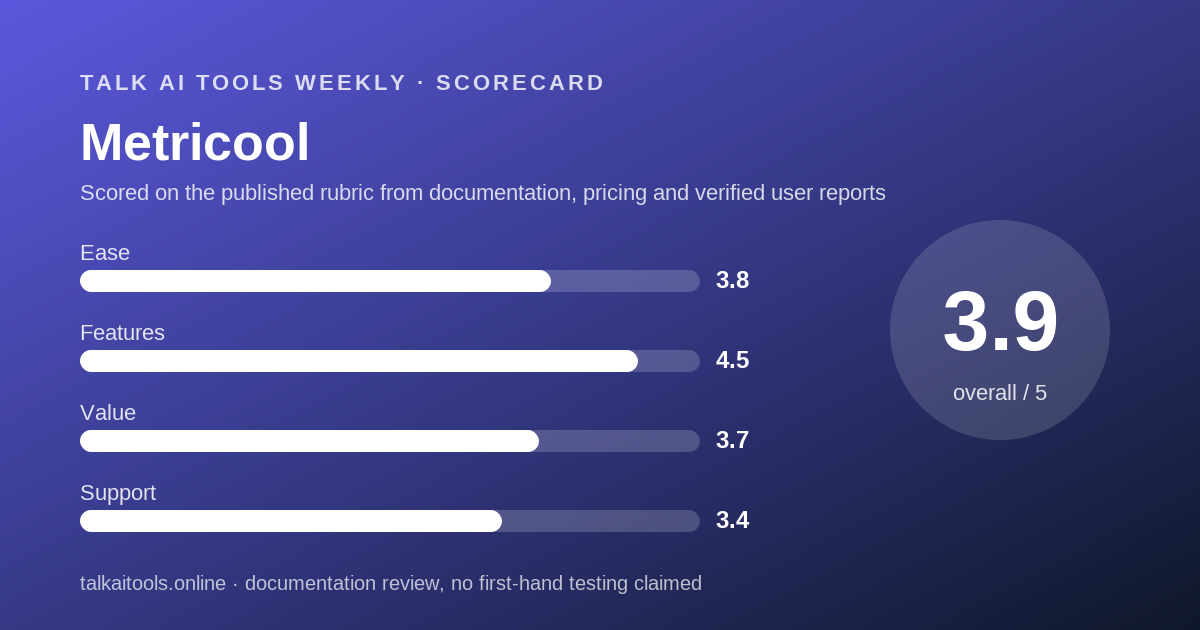
Scored on the published rubric, from documentation, pricing and verified user reports.
Best for: A freelancer or small agency juggling several client brands who needs paid-ad reporting and a stated European data boundary.
Verdict
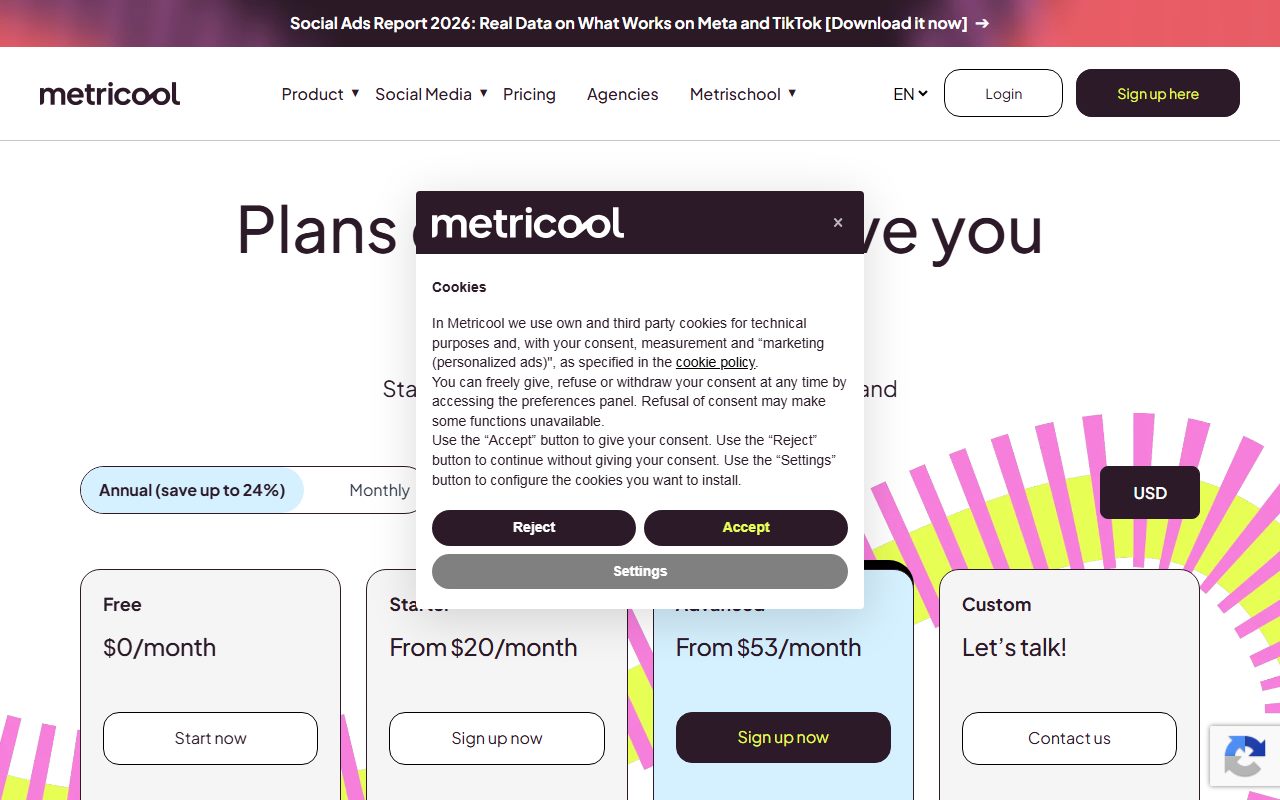
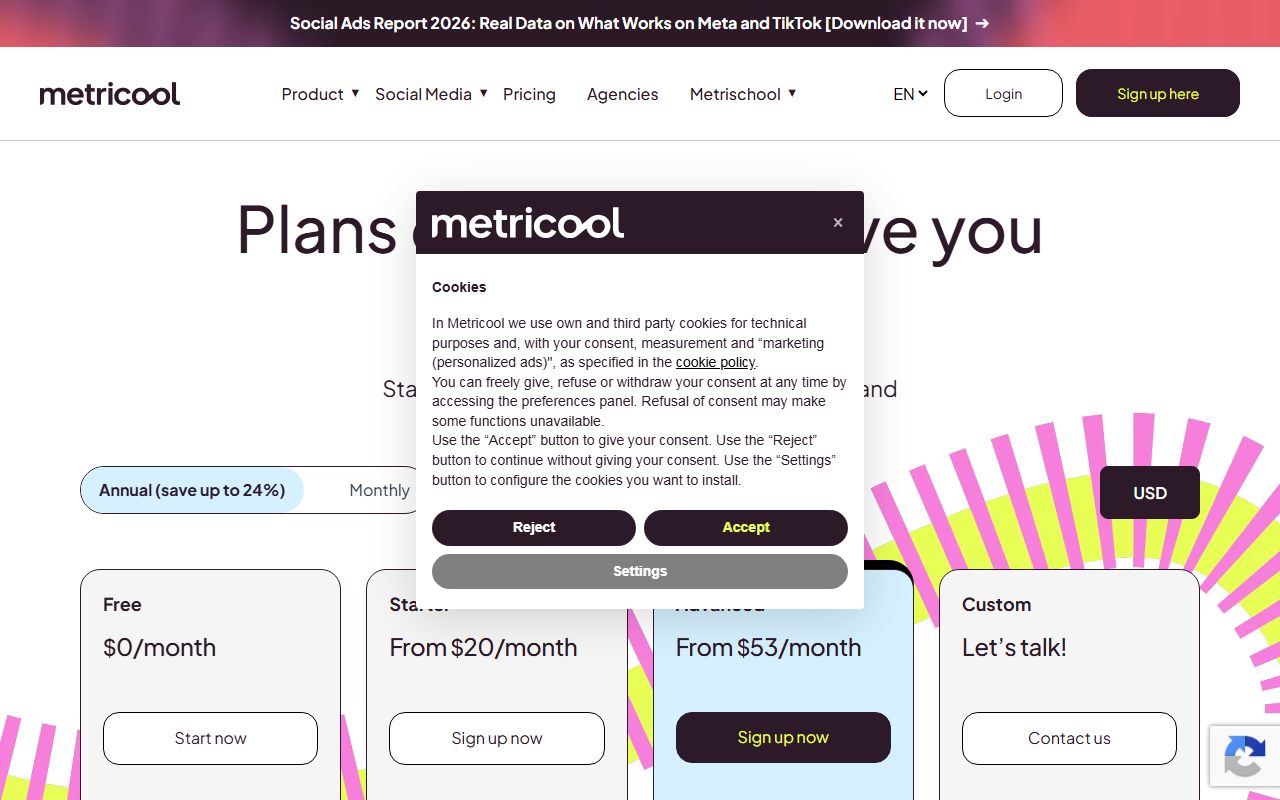
Metricool is the analytics tool in this cluster that also schedules, and it is priced by brand rather than by account or by seat. This is a documentation review, built from the vendor's pricing page in its USD view, its privacy policy and its add-on table, all read on October 23, 2026; no account was opened and no first-hand claims are made below. Starter is listed from $20 a month and Advanced from $53 a month with annual billing, each stepping up by brand count to $36 and $159 respectively. Monthly billing is also rendered on the same page at $25 and $67 to start. The depth is real: competitor tracking for up to 100 profiles, ad reporting, report templates, a Data Studio connector and an MCP endpoint. Two things cost it points. The free plan excludes LinkedIn and X, and X analytics sit behind a $10 a month per-account add-on even on paid plans.
Visit Metricool
We have no affiliate relationship with this vendor. Link goes to the official site.
Where it is strong
- The privacy policy states Metricool carries out no international data transfers and stores all data on servers within the European Union
- Both billing frequencies and both currencies render on the same page, so a buyer can read the monthly and annual figure side by side
- Starter lists competitor tracking for up to 100 profiles, which is the kind of number usually reserved for agency tiers
- Advanced adds team and client management, role management and a post approval system from $53 a month billed annually
- Ad reporting and a Data Studio connector make it the only tool in this cluster that can close the loop between organic and paid
- An MCP endpoint is listed on every tier including the free plan, which is unusual in this category as of October 2026
Where it falls short
- The free plan excludes LinkedIn and X, so the two networks most small B2B teams care about are not testable at $0
- X analytics and publishing sit behind an add-on listed at $10 a month per connected account, on top of the plan
- Pricing steps by brand count rather than by account, so one brand with eight profiles and eight brands with one profile each are priced very differently
- The top tier lists custom AI assistant credits, implying lower tiers have a credit allowance, yet no per-plan credit number is printed where we looked
- The add-on table shows two starting prices next to the Advanced Analytics and Canva rows without clearly assigning either figure to either row
At a glance
| Starting price | $0 free plan; Starter from $20 a month billed annually, $25 a month billed monthly (pricing page, USD view, October 23, 2026) |
|---|---|
| Pricing note | Free plan at $0; Starter listed from $20 a month and Advanced from $53 a month with annual billing, rising to $25 and $67 on monthly billing (pricing page, USD view, checked October 23, 2026) |
| Free plan | Yes - 1 brand, 20 scheduled posts a month, 5 competitor profiles, 30 days of analytics, AI assistant, MCP; excludes LinkedIn and X |
| Billing unit | The brand. Starter covers up to 10 brands, Advanced up to 50, Custom is quoted on request |
| Brand tiers (annual, USD) | Starter $20 for 5 brands, $36 for 10; Advanced $53 for 15, $85 for 25, $159 for 50 |
| Brand tiers (monthly, USD) | Starter $25 for 5 brands, $45 for 10; Advanced $67 for 15, $107 for 25, $210 for 50 |
| Add-ons | X add-on $10 a month per connected account; Hashtag Tracker $25 a day for X and $25 a day for Instagram |
| Annual saving | The toggle is labelled save up to 24 percent; the figure varies by tier on the printed numbers |
| Data residency | The privacy policy states no international transfers and all data stored on servers within the European Union |
What Metricool actually is
Metricool is an analytics product with a publishing calendar attached, and the order matters when you read the price.
The feature list leads with reporting: Metricool Studio, campaign dashboards, PDF and PPT reports, a Data Studio connector, competitor tracking and ad analytics. Scheduling is one module among several.
The billing unit is the brand. A brand is a set of connected profiles for one business or client, and plans are sold by how many brands you need rather than how many accounts or people.
That makes the tool cheap for one agency with ten small clients and expensive for one business with ten profiles on a single brand.
The company is Spanish, based in Majadahonda, Madrid, and its data posture follows from that. Nothing else in this cluster makes the claim its privacy policy makes about where data sits.
For readers who have followed how metering is spreading through small-team software in the spotlight on AI credit meters, Metricool is the counter-example: the meter here is organisational, not consumption-based.
Who Metricool is best for
The fit is someone who has to produce a report, not just a post.
- A freelancer or two-person agency with between five and fifteen client brands to report on monthly
- A team that runs paid campaigns alongside organic and wants both in one dashboard rather than two exports
- An organisation with a hard requirement that customer data stay inside the European Union
- A buyer who needs an approval queue with roles before content goes out, which Advanced lists
- Anyone who needs a client-facing report template rather than screenshots pasted into a deck
- A technical buyer who wants the Metricool API through Zapier or Make, or the MCP endpoint listed on every tier
Who should skip it
Three groups will pay for shape they do not need.
- Anyone running a single brand with many profiles, because brand slots are the meter and most will sit empty
- Anyone who wanted to test LinkedIn or X scheduling before paying, since the free plan excludes both
- Anyone whose reporting lives on X, because X analytics carry a $10 a month per-account add-on on top of the plan
What the free plan includes as of October 2026
The free tier is a real analytics account with a deliberate network gap.
Per the pricing page read October 23, 2026 in its USD view, Free covers 1 brand, up to 20 scheduled posts a month, 5 competitor profiles, 30 days of analytics history, the AI social media assistant and the Metricool MCP.
Twenty posts a month is a genuine monthly quota, not a refilling queue. On a brand posting daily it runs out before the third week.
The gap is stated on the plan card itself: the free plan manages all your brands' social networks except LinkedIn and Twitter. LinkedIn connection is listed as a Starter feature and X is sold as an add-on.
That is an honest disclosure in an awkward place, and it is the single most important line on the free tier. A small B2B team evaluating Metricool for LinkedIn cannot evaluate it for LinkedIn without paying.
What survives on Free is the part most vendors withhold: competitor tracking, however shallow, and an MCP endpoint.
How the pricing is structured
There are four tiers, two billing frequencies, two currencies and a brand-count step inside each paid tier. All figures below are the USD view of the pricing page, checked October 23, 2026.
On annual billing, labelled save up to 24 percent: Free is $0. Starter is listed from $20 a month, with up to 5 brands at $20 and up to 10 brands at $36.
Advanced is listed from $53 a month, with 15 brands at $53, 25 brands at $85 and 50 brands at $159.
On monthly billing, the same page renders Starter from $25 a month, with 5 brands at $25 and 10 brands at $45. Advanced starts at $67 a month, with 15 brands at $67, 25 brands at $107 and 50 brands at $210.
The page also renders a full EUR block. We quote USD only and have converted nothing.
Two add-ons are priced unambiguously: the Twitter and X add-on at $10 a month per connected account, and the Hashtag Tracker at $25 a day for X and $25 a day for Instagram.
Two more are not. The add-on table places two starting prices beside the Advanced Analytics and Canva rows without clearly assigning either figure to either row, so we print neither.
Ease of use: what the 3.8 is built from
Ease scores 3.8 of 5, graded on onboarding clarity, published limits and how quickly a buyer can self-serve a total.
The pricing page does something most rivals in this cluster do not: it renders both billing frequencies and both currencies, so the annual and monthly figures can be compared without starting a signup.
It also prints every brand-count step rather than hiding the ladder behind a slider, which makes the jump from 25 to 50 brands visible before you commit.
The deduction is conceptual rather than cosmetic. A buyer has to translate their own setup into brands before any price makes sense, and brands are the vendor's unit, not the buyer's.
The second deduction is the add-on sheet, where two prices sit beside two feature rows without a clear mapping, and where the X surcharge is easy to miss until the invoice.
We did not evaluate the interface and make no claim about it. Only the documentation was read.
Features: the deepest list in this cluster
Features score 4.5 of 5, the strongest column on this card, and the depth is in reporting rather than publishing.
Starter already lists unlimited content publishing, competitor analysis for up to 100 profiles, PDF and PPT reports, analytics with unlimited history, multiple link-in-bio pages, Flows, and Google Drive plus Canva integration.
Advanced adds the agency layer: team and client management, role management, a post approval system, complete X analytics, customisable report templates, the Data Studio connector and the Metricool API through Zapier and Make.
Ad reporting is the genuine differentiator. Nothing else in this cluster closes the loop between paid spend and organic performance in one dashboard on a published price list.
The AI side is where the documentation stops short. An AI social media assistant is listed on every tier and custom AI assistant credits appear on the top tier, which implies a credit allowance in between.
No per-plan number appeared in the markup we read, and we are not going to supply one.
If the writing itself is the bottleneck rather than the reporting, our Jasper review covers that tool class and Surfer SEO against Frase covers the search-brief end.
Value: good per brand, awkward per profile
Value scores 3.7 of 5, graded on what the published price buys at one, five and twenty users.
At one user with one brand, Free is usable for measurement but not for publishing, because 20 posts a month is a real ceiling and LinkedIn is absent.
At five brands, $20 a month on annual billing for competitor tracking, unlimited publishing and report exports is strong value on the printed numbers.
At twenty-five brands, $85 a month on annual billing works out to $3.40 a brand by our arithmetic, which is the cheapest per-client figure we read anywhere in this cluster.
The awkwardness is the other direction. One brand with eight profiles still consumes one brand slot, so a single business pays for a ladder it cannot climb.
And the X surcharge compounds. Four X accounts at $10 a month each is $40 a month by our arithmetic, which can exceed the plan itself at Starter level. That is the sort of second meter we flagged in the week Copilot split the bill.
Support: the slowest public replies in this cluster
Support scores 3.4 of 5, the lowest column on this card, and the score rests on an absence rather than a complaint.
No response-time commitment is published for any tier on the pages we read on October 23, 2026. A dedicated account manager appears only on the Custom plan, which is quoted on request.
Trustpilot's own transparency panel for metricool.com, read the same day, states the company replied to 100 percent of negative reviews and typically replies within 1 week.
One hundred percent of negative reviews answered is a good signal about intent. One week is the slowest of the three figures we read in this cluster.
That panel measures public review replies, not support tickets, and we will not present it as a service level.
We did not measure support response times and will not estimate them. The score reflects published channels and documentation against an absent commitment.
What verified users report
Public sentiment is solid, from a sample large enough to mean something and labelled with a caveat by the platform itself.
On Trustpilot, read October 23, 2026, metricool.com carries a TrustScore of 4.1 out of 5 rated Great. The page header showed 686 reviews while the page's own structured data reported 675 on the same date, so treat the count as approximate.
Trustpilot labels the company as having no recent history of asking for reviews, and warns on the same panel that the sample may therefore not be representative. Unsolicited samples usually skew toward people with a reason to write.
A 4.1 from roughly 680 unsolicited reviews sits in a credible band. It is neither the loyal-base profile of the highest-rated tool in this cluster nor a warning sign.
We quote no G2 or Capterra figure here. Where an aggregator could not be opened, no number from it appears.
Limits and data handling stated by the vendor
This is the clearest data-residency statement we read in this category, and it is worth quoting closely.
The privacy policy states that Metricool Software does not carry out international data transfers in the process, and that it stores all data on servers within the European Union.
That is a stronger claim than the usual formula. Most vendors say transfers happen under Standard Contractual Clauses or a framework. This one says the transfers do not happen.
The policy also defines its own roles explicitly: Metricool Software as owner, an Administrator as the professional or agency managing accounts, and a Brand as the party whose accounts are managed. That separation matters for an agency deciding who is controller for client data.
On retention it is specific rather than open-ended, citing six years for accounting records under article 30 of the Spanish Commercial Code alongside the general contractual period.
What the document does not say, as far as we could read it on October 23, 2026, is whether customer content passes to a model provider for the AI assistant.
That is the same unanswered question we raised in the spotlight on usage policy and human review, and it is the one thing a European data boundary does not settle by itself.
Alternatives worth reading before you decide
Four alternatives cover most of the reasons a reader would reject Metricool. Figures come from each vendor's own pricing page, read October 23, 2026.
Choose Buffer if the job is publishing and the team is the variable. Its Team plan is listed at $10 per channel per month with annual billing and publishes unlimited team members, with no brand concept to translate into.
Choose Publer if you want competitor analytics without a brand ladder. Business is listed at $10.00 a month per social account and includes competitor analysis, hashtag analytics, best times to post and API access.
Choose SocialBee if you want profile-count pricing with no network exclusions at entry. Bootstrap is listed at $29 a month billed monthly, or $24.2 a month billed annually, for up to 5 social profiles.
Choose Hootsuite if a per-seat enterprise contract is normal for you. Standard is listed at $99 per user per month on annual billing, covering 10 social accounts, which is roughly the price of Metricool Advanced at 50 brands.
Otherwise choose Metricool if reporting is the deliverable and European hosting is a requirement.
Bottom line
Metricool earns 3.85 of 5 on our four-column rubric and is the deepest reporting tool in this cluster.
It is the right pick for a freelancer or small agency with several client brands who has to send a report, needs paid and organic in the same view, and wants a stated European data boundary.
It is the wrong pick for a single business with many profiles, because brand slots are the meter, and for anyone whose plan centres on X, because X carries a $10 a month per-account surcharge.
Before buying, do three things. Count your brands rather than your profiles. Add the X surcharge for every X account you run.
Then check whether the AI assistant allowance on your tier is published anywhere by the time you read this, because it was not on October 23, 2026.
Every figure above was read in the USD view of the vendor's own pricing page on October 23, 2026, with no currency converted by us.
For related reading, our Krisp review and Fathom review cover the meeting half of a small team's stack, our shortlist of AI meeting note takers applies the same rubric, and Chatbase covers the inbound side.
Buy it if
- You report on paid and organic together, because ad reporting and a Data Studio connector are published features rather than enterprise extras
- You manage distinct client brands, since the meter is the brand and Starter covers up to ten of them
- A European data boundary is a requirement, which the privacy policy states in plain words
- You need an approval queue with roles, which Advanced lists from $53 a month billed annually
Skip it if
- You want to trial LinkedIn or X scheduling at $0, because the free plan excludes both networks
- X is central to your reporting and a $10 a month per-account add-on on top of the plan is unacceptable
- You run one brand with many profiles, because you pay for brand slots you will never fill
Frequently asked
Does Metricool have a free plan?
Yes. The pricing page, checked October 23, 2026, lists a $0 plan for 1 brand with up to 20 scheduled posts a month, 5 competitor profiles, 30 days of analytics, the AI social media assistant and the Metricool MCP. LinkedIn and X are excluded.
How much does Metricool cost for 5 brands?
The pricing page prints this tier directly rather than leaving it to arithmetic. Up to 5 brands is listed at $20 a month on annual billing and $25 a month on monthly billing, in the page's USD view read October 23, 2026.
Why is X extra on Metricool?
The vendor sells X as a separate line. The pricing page lists a Twitter and X add-on at $10 a month per connected account, and the free plan excludes X entirely. Complete X analytics are listed as an Advanced plan feature.
Is Metricool priced in euros or dollars?
Both. The pricing page carries an EUR and USD toggle, and both blocks rendered on the page we read on October 23, 2026. We quote the USD figures throughout and have not converted any currency ourselves.
How many AI credits does each Metricool plan include?
We could not read a per-plan figure. The plan cards list an AI social media assistant on Free and custom AI assistant credits on the top tier, which implies a credit allowance on the tiers between, but no number appeared in the page markup we read.
Where does Metricool store customer data?
The privacy policy states that Metricool Software carries out no international data transfers and stores all data on servers within the European Union. The company address on the same document is in Majadahonda, Madrid, Spain.
Sources
- Metricool pricing page, USD and EUR views - checked October 23, 2026
- Metricool privacy policy - checked October 23, 2026
- Metricool reviews on Trustpilot - checked October 23, 2026
- Buffer pricing page (used in the alternatives section) - checked October 23, 2026
- Publer plans page (used in the alternatives section) - checked October 23, 2026
- Hootsuite plans page (used in the alternatives section) - checked October 23, 2026
Update history
- October 23, 2026 - First publication. Plan prices read from the USD view of the vendor's pricing page on this date, with both annual and monthly blocks rendered; EUR figures also present and not converted. Per-plan AI credit allowances did not render and are not quoted. Advanced Analytics and Canva add-on prices were not clearly mapped to their rows, so neither is quoted. Privacy policy, add-on table and Trustpilot panel read the same day.
Visit Metricool
We have no affiliate relationship with this vendor. Link goes to the official site.